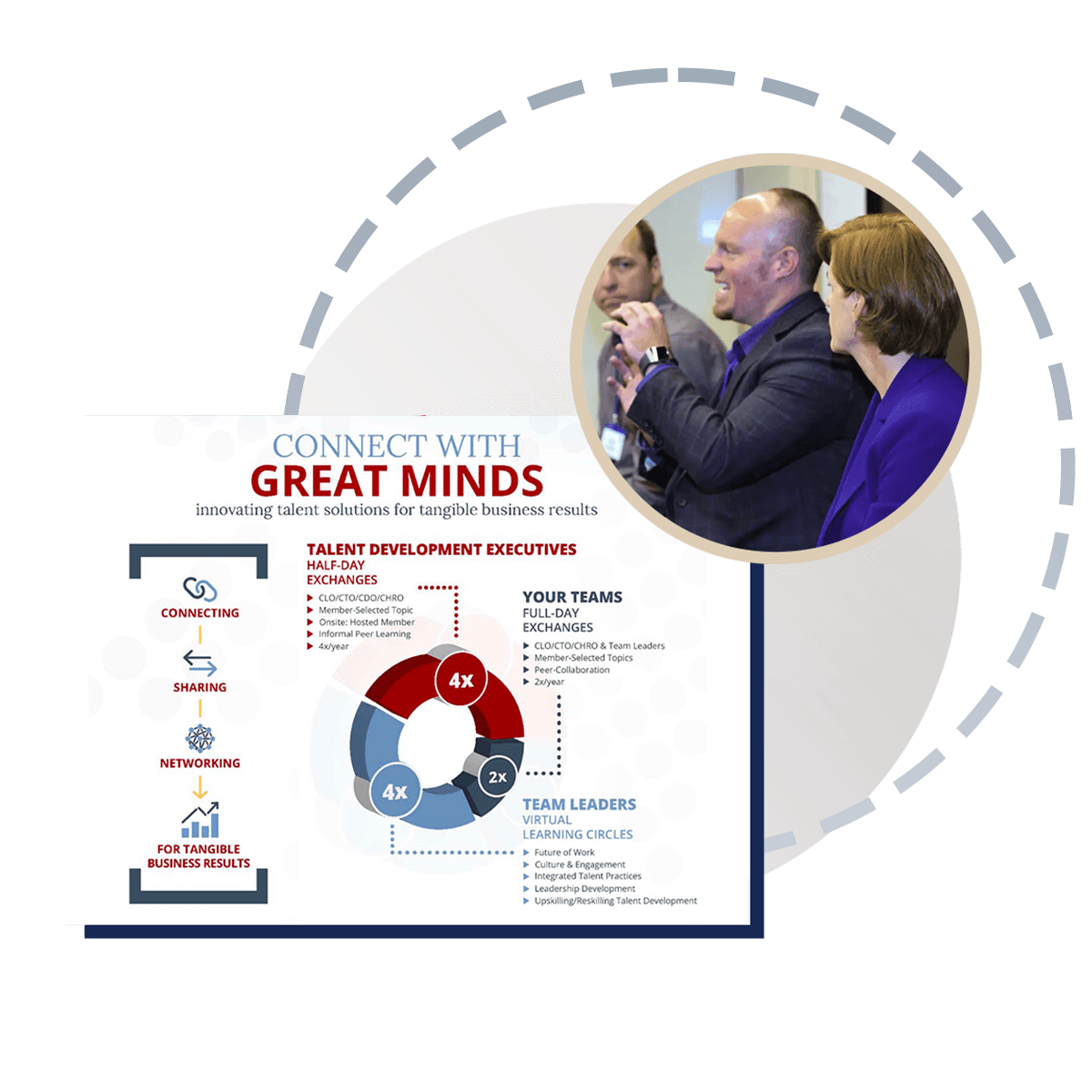
This moment video is from the January 23, 2026 ELE Ideation Sprint — Reskilling Closer to Real Work.
“Most of what surfaced here has nothing to do with learning—and everything to do with how work is designed.” — Brian Gold, Acrisure.
This real-time exchange offered a clear reminder that many of today’s capability challenges don’t show up as skills gaps. They surface quietly—in manager workarounds, ambiguous decisions, and teams absorbing more risk than expected just to keep work moving.
What leaders heard wasn’t a call for more training. Managers weren’t asking for new programs or tools. They were describing work that had changed without being formally redesigned: roles stretching beyond their original scope, expectations shifting without conversation, and decision rights that were no longer clear. That friction isn’t noise. It’s signal.

Three insights felt especially important for leaders designing team-based learning experiences:
First, manager conversations are the earliest capability sensor.
When leaders look across manager input—not one story at a time, but in patterns—they can spot role drift, uneven adaptation, and system strain long before performance metrics catch up. Capability gaps show up as hesitation, overload, and uncertainty—not as requests for courses.
Second, many “reskilling” challenges are actually design challenges.
Unclear workflows, broken handoffs, and ambiguous decision ownership can’t be trained away. Capability grows when leaders slow down long enough to diagnose whether the issue is skill, system, or structure—and respond with intention rather than reflex.
Third, learning works best in the flow of real work.
The most momentum came from shared sense-making: managers comparing signals, testing small changes, and learning together while solving real problems. These moments build clarity and confidence at the same time—without pulling people away from the work itself.
The bigger shift isn’t about better programs or faster deployment. It’s about designing experiences that help teams see what’s changed, make smarter decisions together, and adapt in real time
“This gives L&D a way to go back to the business with real value—not just more programs.” — Brian Gold, Acrisure.
That’s the kind of capability-building work that will matter most in 2026.
𝐀𝐁𝐎𝐔𝐓 𝐓𝐇𝐄 𝐒𝐏𝐑𝐈𝐍𝐓: The ELE Ideation Sprint focuses on reskilling closer to real work. Rather than starting with large-scale frameworks or tools, the Sprint centers on practical manager–employee skill conversations and the early signals that reveal where capability is actually breaking down.
𝐐𝐔𝐄𝐒𝐓𝐈𝐎𝐍𝐒? Explore the ELE Ideation Sprint FAQs or reach the ELE team at help@ele.llc.