ELE Ideation Sprint — Reskilling Closer to Real Work (FAQs)

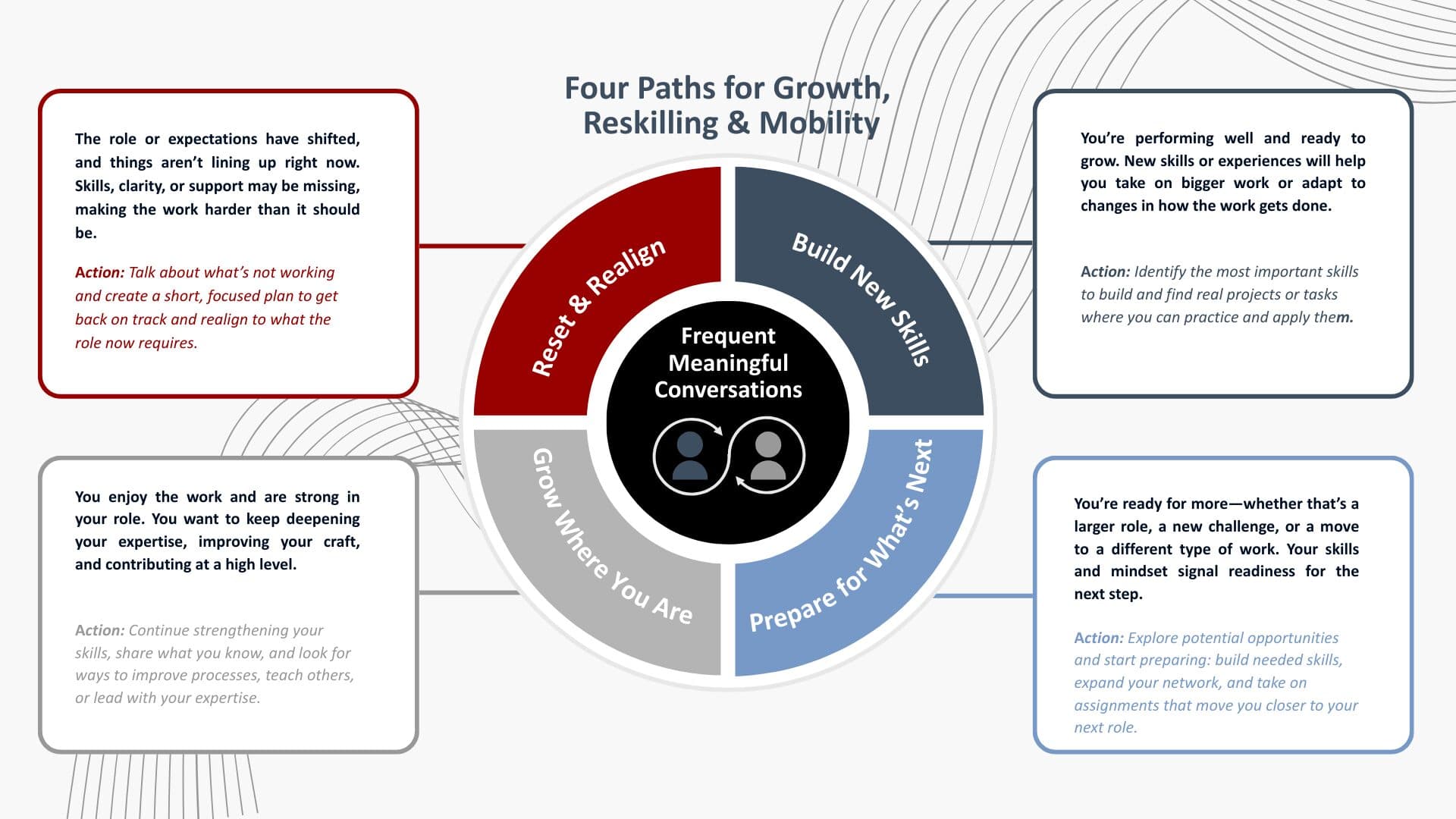
ELE’s four years of research found that reskilling stayed too far from real work. Managers need practical tools they can use in real time. Because early reskilling signals show up in everyday conversations, this diagram helps managers recognize them and guide clear, skill-focused next steps.


Semi-Synchronous Collaborative Learning
A blend of one short weekly session plus flexible async collaboration, the cohort manages together.

Duration: 2–3 weeks (Ideation Sprint is 1st of 4 planned)
Time Commitment: 2–4 hours/week (one live session; rest async)
Cohort Size: 4–8 ELE member organizations


Why This Ideation Sprint Matters
HR has always owned enterprise reskilling, but over time, the process became too complicated to use in real time. Managers lacked simple tools, and HR lacked visibility into daily workflow needs. This sprint closes that gap by co-creating a lighter, practical, work-centered approach.

We’ll apply Design Thinking to reframe reskilling so it’s rooted in the flow of work—shaped by what managers need and by what OD/L&D must enable at scale.

And we’ll start where early reskilling signals naturally emerge—during the Frequent Meaningful Conversations (FMCs) where managers and employees discuss changing work, capability gaps, and readiness for what’s next.

To keep the Sprint grounded in real work, we won’t begin with solutions, tools, or frameworks. We’ll begin with the real conversations where reskilling needs show up.

FAQ Banner Image

Authors

Azizeh Constantinescu
Newt Moore
Dirk Tussing
Deepa Kartha
Angelica Stilling
Jerry Oliveira

    What problem is this innovation sprint solving?

    View

    Enterprise reskilling became too complex to use in real time.

    Managers lacked simple, practical tools — and HR lacked visibility into day-to-day workflow needs.

    This sprint closes that gap by co-creating a lighter, practical, work-centered approach grounded in the real conversations where employee reskilling needs surface.

    What is the structure of this Innovation Sprint?

    View

    For this Sprint, we are completing Stage 1 — Ideation only.
    We’ll begin discovery where reskilling signals actually show up: during  Frequent Meaningful Conversations (FMCs) between managers and employees.

    All ELE Innovation Sprints follow a consistent 4-stage structure:

    1. Ideation  Identify challenges, compare existing approaches, and define desired outcomes.
    2. Design — Build frameworks, playbooks, tools, and implementation guidance.
    3. Validation — Test early solutions with target groups and capture lessons learned.
    4. Reflection — Refine, simplify, and package the final ELE frameworks and tools.

    This structure keeps the sprint disciplined and practical—exploring the problem deeply, designing workable solutions, validating them with real users, and strengthening them through reflection and iteration.

    Who should participate in the cohort?

    View

    Leaders responsible for talent, learning, workforce strategy, OD, or transformation who want a lighter, more practical approach to reskilling.

    Cohorts typically include 6–10 senior leaders from diverse organizations, offering cross-industry perspectives and real-world use cases.

    This Sprint is not a good fit for anyone looking to “just observe” rather than actively contribute.

    What is the time commitment?

    View

    The full Sprint runs 7–10 weeks with a 2–4 hour weekly commitment, which typically includes:

    • a 60–90 minute kickoff
    • weekly, working live sessions
    • async collaboration between meetings
    • a final Solution Exchange to share outputs

    Most leaders say the cadence is manageable and energizing.

    As a self-managed cohort, members set the meeting rhythm together to ensure the Sprint stays engaging and workable for everyone.

    At the end of each sprint, the sprint members can decide whether to move forward to the next sprint.

    Each sprint will need a minimum number of participants to proceed.

    You can expect the following timeframes for each type of sprint. The sprints need not be contiguous. The focus is on creating working prototypes out of each of the sprints.

    1. Idea Sprint - 2-3 weeks
    2. Design Sprint - 2 weeks
    3. Implementation Sprint 2-4 weeks
    4. Reflection Sprint 1 week

    Do I need prior experience with reskilling, OD, or Design Thinking?

    View

    No. You don’t need any specialized background in reskilling, OD, or Design Thinking to participate.

    This Sprint is built for senior leaders who bring real work experience, not formal methodology training. We’ll walk through the tools together, apply them directly to real scenarios, and learn from one another along the way.

    If you bring curiosity, openness, and a willingness to collaborate, you’re more than ready.

    How will Design Thinking guide this Innovation Sprint?

    View

    Design Thinking gives us a fast, practical way to unpack what’s really happening in the work, generate smarter options, and test lightweight solutions before anyone invests heavily.

    All you need is your experience, curiosity, and readiness to learn with — and from — other senior leaders. No technical tool expertise or AI expertise required — just your experience, insights, and willingness to experiment alongside fellow line-leader colleagues.

    What are the Two Lenses on Reskilling?

    View

    Manager Lens

    • Starts with real work problems, not programs.
    • Uses Frequent Meaningful Conversations (FMCs) to spot readiness, gaps, and where reskilling or upskilling is needed.
    • Focuses on development in the flow of work.

    OD/L&D Lens

    • Shifts from programs to strengths-based, role-centered guidance.
    • Uses design-thinking tools to help managers and employees reframe roles and opportunities.
    • Builds systems that are adaptive, human-centered, and scalable.

    Together, these lenses help the cohort see both the day-to-day signals and the enterprise changes needed to make reskilling actually work.Four Paths for Reskilling (ELE)

    Relevant research:

    What does Reskilling Best Practice Looks Like in Real Life?

    View

    1. Why We’re Starting Here: Real Conversations, Not Big Systems

    Across four years and 50+ skills roundtables, ELE saw the same pattern:

    Reskilling was happening on paper—not in the flow of real work.

    For ELE's 2026 Reskilling Ideation Sprint, we’re intentionally narrowing the lens.

    We’re not tackling enterprise-wide reskilling models or building giant skills databases.

    We’re putting the microscope where it matters most: On the actual manager–employee conversations where reskilling signals show up.

    Those conversations—not frameworks, tools, or heatmaps—tell us what work is changing, where skills are shifting, and what support people need next.

    2. What does Reskilling Best Practice Looks Like in Real Life?

    The clearest example didn’t come from a big reskilling program. It came from something much simpler.

    When Geovanny was at CNA Insurance, he showed that:

    A simple, structured manager–employee conversation — supported by lightweight tools — can make reskilling practical, human, and immediately actionable.

    • Managers felt more confident.
    • Employees felt more supported.
    • And the work improved.

    Here’s a short clip where Geovanny breaks it down:

    Geovanny showed how a simple, structured manager–employee conversation — supported by lightweight tools — can make reskilling practical, human, and immediately actionable.

    SOURCE: Insight: How to Identify Employees that Need Reskilling | ELE Group

    3. This Is the Spirit We Want to Capture in Stage 1 (Ideation)

    ➡️ Start with real conversations — what managers and employees are actually saying about the work, not what we assume they need.

    ➡️ Keep it simple and skills-centered — no annual review energy, no heavy process.

    ➡️ Build reskilling solutions from real signals, not from abstract models or layered workflows.

    What happens after the Sprint ends?

    View

    At the end of the Sprint, you'll have a working prototype, a clearer understanding of where reskilling signals show up in real work, and a validated problem statement your leaders can align around.

    What comes next is up to your organization:

    • Many teams choose to refine, test, or pilot their prototype with a broader group.
    • Others use their new clarity to advance internal work already underway.
    • And if you want support, ELE Solutions can help you evolve the prototype into a scalable approach — but that’s entirely optional.

    The Sprint is designed to create momentum and practical next steps, without locking you into anything beyond the work you’ve co-created.

    What will my team walk away with?

    View

    You’ll leave with:

    • a usable reskilling prototype — workflow-ready, manager-friendly, and realistic to roll out in weeks, not years
    • a shared framework for spotting real reskilling signals in day-to-day work
    • actionable tools your managers and L&D partners can use immediately
    • peer-tested insights from other organizations tackling similar challenges
    • a repeatable method you can apply to future capability, workforce, or transformation initiatives

    What will my organization walk away with?

    View

    You’ll leave with:

    • a usable reskilling prototype — workflow-ready, manager-friendly, and built to test in real work (a first version, not a finished solution)
    • a clear, shared way to identify reskilling signals that show up in real conversations and day-to-day work
    • a reframed problem statement your leaders can align around, grounded in what’s actually happening—not assumptions
    • a validated starting point that creates a natural pathway for ELE Solutions (or your internal teams) to develop and implement next-step solutions

    How do I join this sprint cohort or express interest?

    View

    Reach out to Dirk Tussing to discuss availability and whether the Sprint is a good fit for your team.

    Cohort 1 begins in Q1 2026, with limited openings to keep the experience focused and collaborative.

    Who are the cohort members for Q1 2026 Reskilling?

    View

    As we limit each cohort to 4–8 ELE member organizations, the following ELE Members have been approved:

    Sprint Leaders:

    Cohort Members:

    Status: RECRUITING COHORT MEMBERS
    Planned Start Date: TBD (Targeting Q1 2026)

    Why are we using a "Design Sprint" framework for reskilling?

    View

    While the Design Sprint originated in the tech world, its core power lies in reducing risk and accelerating clarity. In our "Reskilling Closer to Real Work" initiative, we treat our talent strategy as a "product" that must be useful, intuitive, and effective for our employees.

    If you want to dive deeper into the mechanics of this process, we highly recommend the book Design Sprint: A Practical Guidebook for Building Great Digital Products by Richard Banfield, C. Todd Lombardo, and Trace Wax.

    Why it’s a must-read for this Sprint: The book provides a step-by-step roadmap for the exact phases we use—Understand, Diverge, Converge, Prototype, and Test. For HR and L&D leaders, it offers a practical toolkit to stop the cycle of "endless planning" and move toward rapid validation. It helps us ensure that the reskilling pathways we build aren't just well-intended programs, but "products" that employees actually want to use to improve their work tomorrow morning.

ShareCopy