"There's no way in today's crazy busy schedule that a series will actually have the right people." — Dirk Tussing
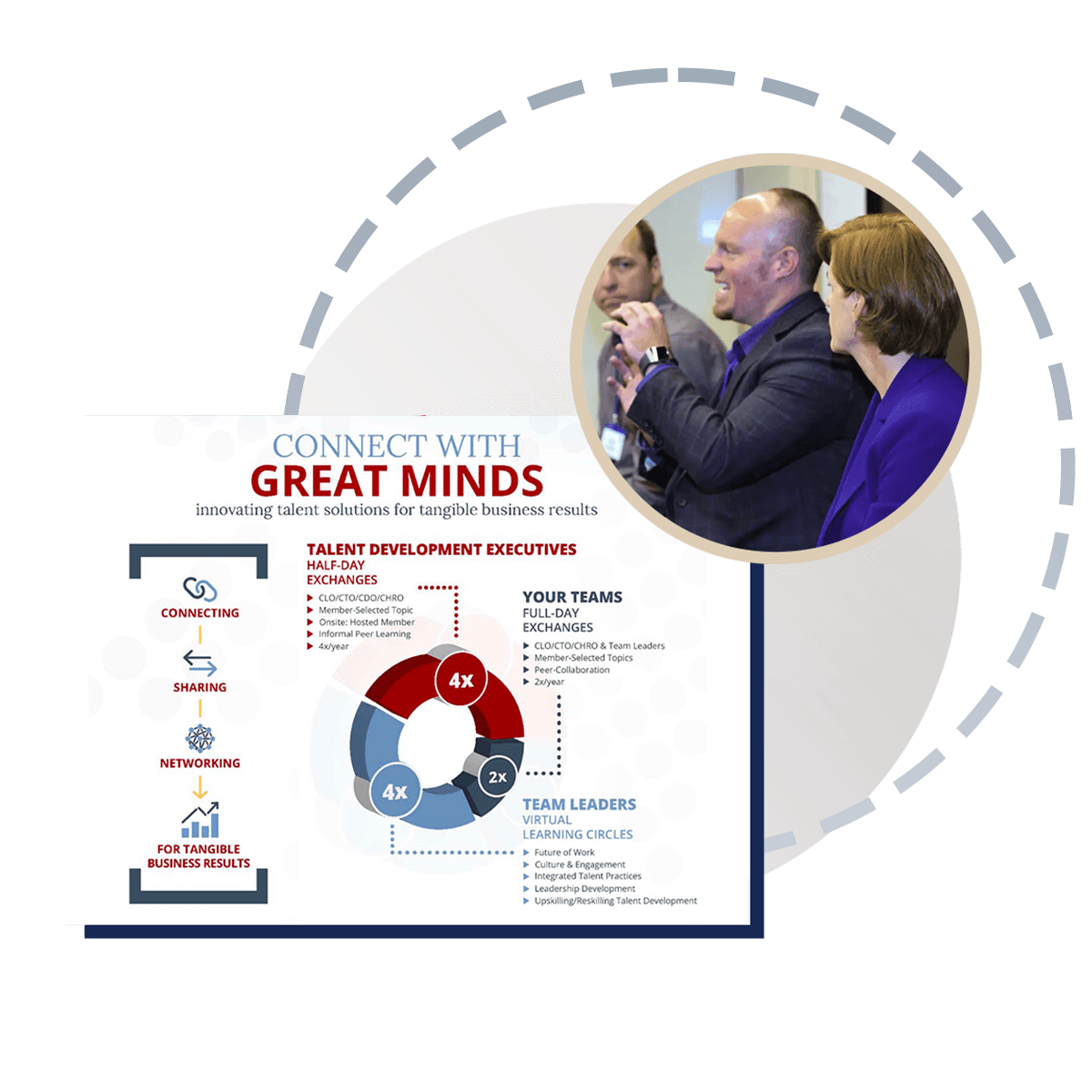
The real work the ELE community is moving forward isn't a program refresh — it's a structural shift in how peer intelligence gets built and activated. For years, the community ran on a curated calendar: ELE scheduled, ELE sourced speakers, ELE sent the invites. That model hit a ceiling. What's replacing it is an agile, crowdsourced ecosystem where members surface real challenges, self-organize into focused cohorts, and practice problem-solving together — before they need the answer, not after.
This closing exchange made that shift concrete.
Moving the start line
The community has spent years focused on upskilling topics. The reframe in Milwaukee was sharper: stop waiting for training to begin and move the starting point to the live challenge itself.
"Training doesn't end when the class ends. All we're doing is moving the start line." — Dirk Tussing
In practice, this means a practitioner brings a client situation — collected through the Action Planning Worksheet — into a Design Charrette or AI Practical Lab. The community works it in real time. The practitioner walks away with a peer-sourced 30/60/90-day action plan, not a summary deck or a Gartner citation.
It's a different model for how expertise moves. The community becomes the R&D engine, not a backdrop for a speaker.
Shifting from curated to community-built
The hardest thing Dirk said in the room wasn't technical. It was this: the curator model he'd run for 20 years had become the bottleneck.
Top-down scheduling couldn't reliably land the right five people in the same virtual room on the same Friday morning. So the new model inverts it. A member with a challenge submits it. The community votes. Once five aligned people opt in, they set the time — not ELE. ELE handles logistics and socialization. The cohort handles the work.
The July through September calendar on the ELE website is intentionally empty. That's not a gap. That's the invitation.
Informal meetups follow the same logic. Two or three people, a conversation starter, a venue (Chicago regulars tend to land at Cooper Hawks). No formal agenda. The community decides what's worth the time.
"We get caught up in our day jobs and this requires an extra move." — Jane Shlaes
That extra move — submitting a challenge, adding a meetup, showing up to help someone else's problem — is exactly what builds the ecosystem. It compounds. And it only takes five people to start.
Renaming the horizon
Two conference name changes came out of Milwaukee — and they're worth pausing on.
The Milwaukee Conference becomes the ELE Spring Conference. The Chicago event on October 1st at CNA becomes the Fall Talent Intelligence Conference. As Dirk put it plainly: a lot of people in the room aren't from Milwaukee. Geographic names were limiting how the community understood itself and how it showed up to others.
Talent Intelligence is the frame now. Not a location. Not a season. What the community actually does.
From automated workflows to reasoning — a live build
One of the sharpest moments in the closing exchange wasn't planned. Community member Kimberly surfaced that she'd told Chris Olson in a breakout that her action item was to learn how to build an agent — and suspected she wasn't alone. She was right.
Chris Olson, co-founder of Scout, built a functioning AI agent live in the room in under two minutes: a corporate buzzword translator, constructed from a single prompt, with tools selected automatically by the platform.
But the demo's real signal was the distinction Chris drew between automated workflows and agents:
"It moves from giving you information to actually doing work for you." — Chris Olson
Automated workflows are brittle — chain-linked steps that break when one process changes. Agents have reasoning capability. They recognize when something's broken and find another path. They mimic the user's role and permissions rather than operating with unchecked access. They can be evaluated, versioned, and refined over time.
For people leaders watching AI adoption stall inside their organizations, the practical takeaway was direct: start with one repeatable manual task, build a single agent around it, and let it run. The hard part isn't creating it.
"The easy part is creating it, but the hard part is managing it." — Chris Olson
Scout offers a free tier for experimentation. Chris offered continued support to anyone who wanted to keep building after the session wrapped.
What to try next
Three moves you can make on the ELE website right now — no event required:
- Submit a challenge to the voting board. Go to the ELE website and use the top section of the Action Planning Worksheet format: what's getting stuck at work, and why does it matter now. Once enough aligned members vote in, ELE schedules the cohort. You only need five people and a real problem.
- Add a meetup to the summer calendar. July through September is open and community-owned. Name one or two people you'd want to think with, add a conversation starter, and submit it. ELE handles the rest. Informal, no agenda required, often involves a bar tab.
- Check and update your ELE portfolio. Every Zoom appearance, question, slide, and contribution is already building a public profile on the ELE site — with highlight reels. If you've been active, the profile exists. Check it, share the URL, and consider adding it to your email signature. It's a personal brand asset most members don't know they already have.
Bring your work into the room
If this connects to real work you are trying to move forward, bring it into the ELE community. Share the challenge, compare signals with trusted peers, and leave with practical next moves you can use.
Submit My Challenge Now: https://www.ele.llc/faqs/share-top-of-mind-talent-challenges