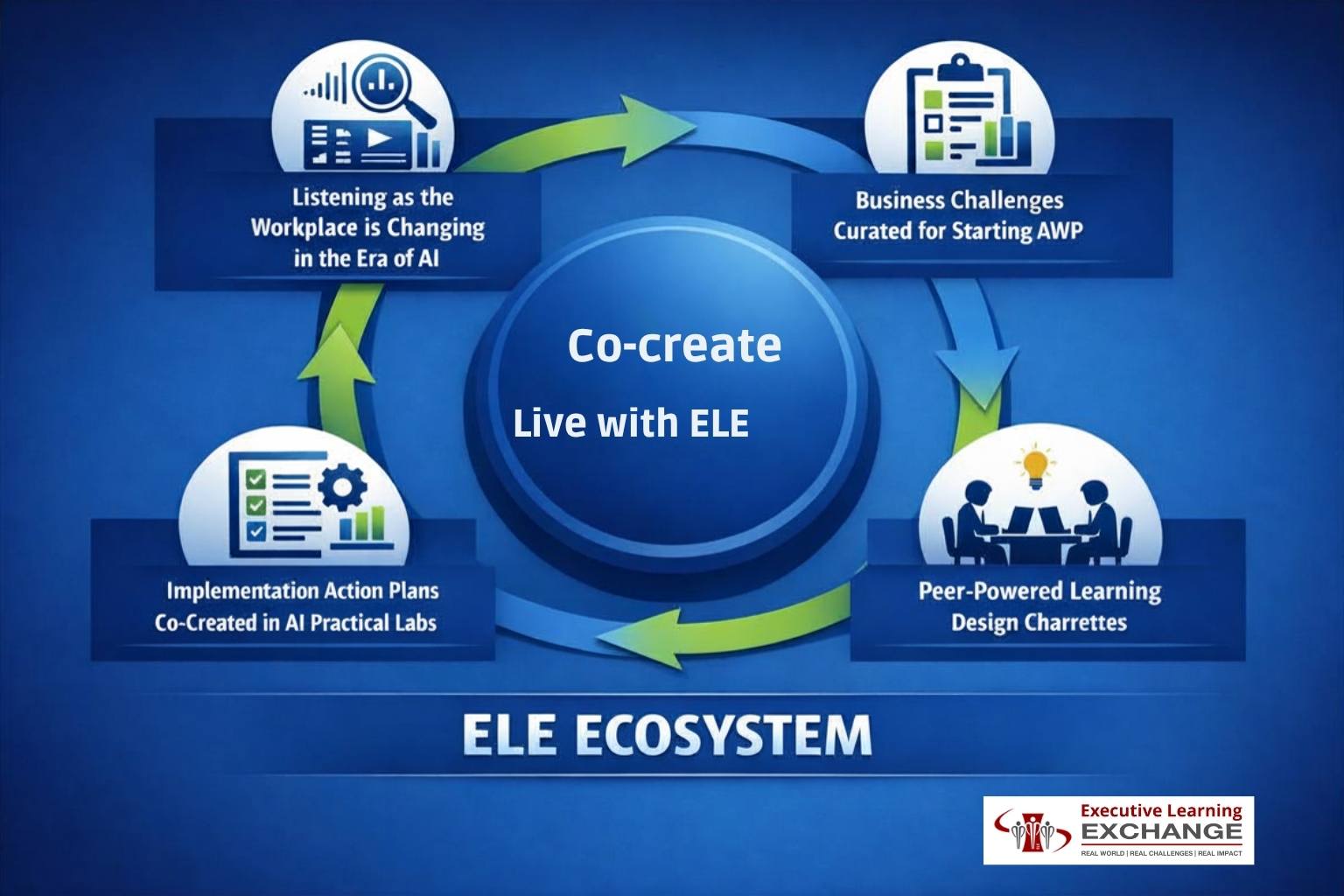
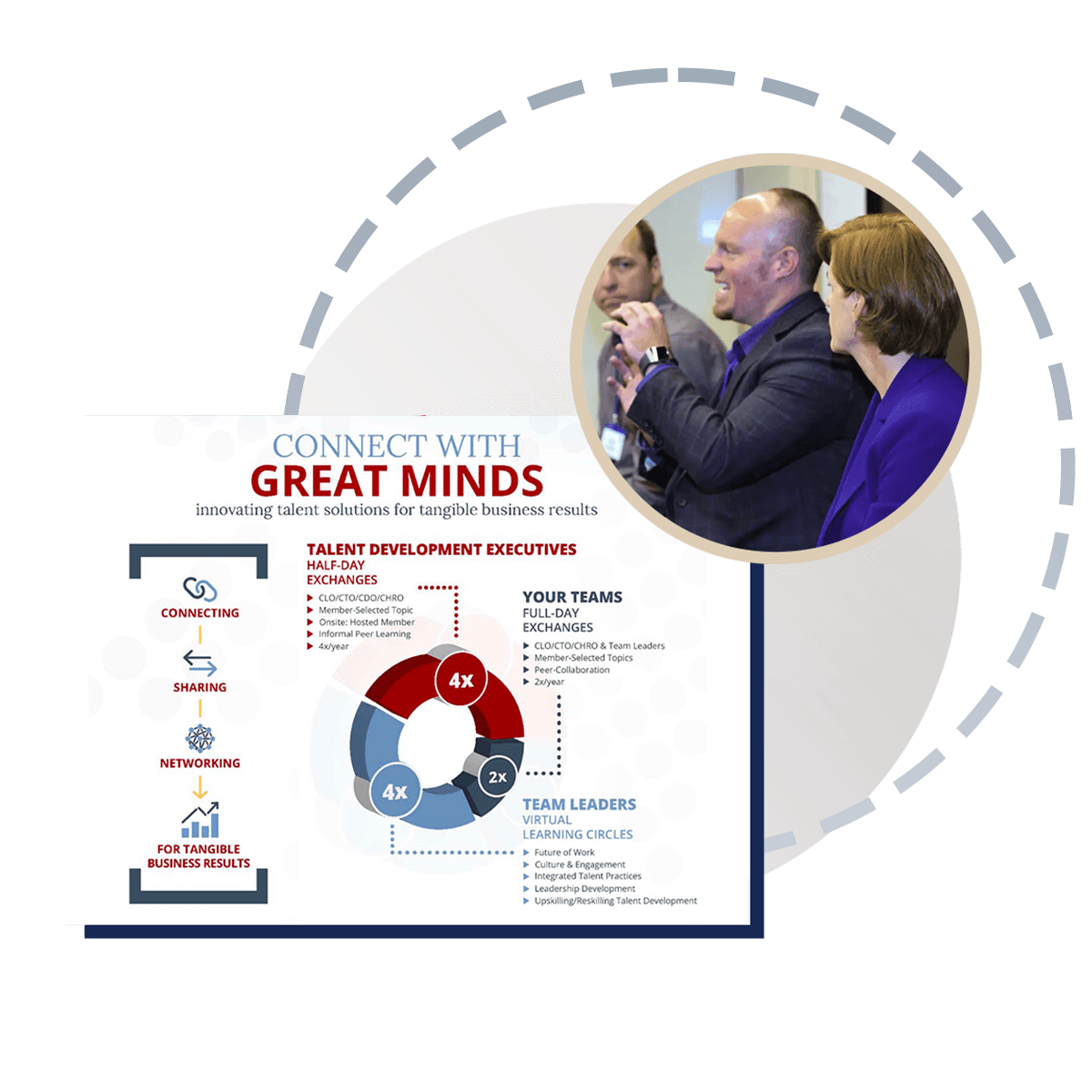
Help Shape ELE Programming: Bring Your Top-of-Mind Business Challenges

ELE’s 2026 programming starts with real business problems leaders are facing now.

Members bring challenges where talent, leadership, and ways of working are part of the solution.

Members can submit their top‑of‑mind business challenges using the ELE submission form: [Submit My Challenge Now]

Share your toughest issue—and we’ll help turn it into a peer-powered working conversation.

Examples include:

  • AI adoption stalling in the flow of work
  • Managers overwhelmed by competing priorities
  • Strategy shifting faster than teams can execute
  • Critical skill gaps appearing mid-work
  • Cross-team collaboration slowing delivery

This shift ensures ELE remains a place where experienced leaders do more than listen—they work through real problems together.

They work together on real problems, strengthening judgment through collaboration and building confidence by testing ideas with trusted peers.

In an era increasingly shaped by AI, leaders don’t just need more information—they need better conversations about real work.

FAQ Banner Image

Authors

Dirk Tussing
Yolanda Mangram
Angelica Stilling

    What kinds of challenges should members submit?

    View

    Members are encouraged to submit top‑of‑mind, in‑practice challenges, such as:

    • Strategic workforce planning and capability shifts
    • Reskilling, upskilling, and redeployment
    • Organization design and operating model changes
    • Leadership readiness and succession
    • Navigating uncertainty, tradeoffs, and transformation

    If the challenge is timely, complex, and benefits from peer insight, it is a strong candidate for ELE programming.

    How will submitted challenges be used?

    View

    Submitted challenges will be reviewed by ELE and used to inform the design of upcoming programming, including:

    • ELE AI Practical Labs — now focused on applying AI to real talent challenges, using Copilot and commonly approved enterprise tools to experiment with peers in practical, work‑based scenarios
    • ELE Design Charrettes — a newer, focused format for small‑group, peer‑powered working conversations
    • ELE Innovation Sprints
    • Curated small‑group working activities
    • Insights: recommendations and recordings

    As AI tools have become part of daily work, ELE’s AI Practical Labs have shifted from tool exploration to applying AI directly to real talent challenges—working alongside trusted peers to test approaches, assumptions, and decisions in context.

    Not every submission will become an ELE Design Charrette, but each helps ELE identify where the community’s energy and urgency truly are.

    How can members submit a challenge for consideration?

    View

    Members can submit their top‑of‑mind talent challenges using the ELE submission form: [Submit My Challenge Now]

    To support thoughtful input, the form is structured around ELE’s Design Charrette Action Planning Worksheet, helping members clearly and efficiently frame their challenge, context, and desired peer support.

    Submissions should briefly describe:

    • The challenge being worked through
    • Why it's timely or pressing right now
    • The type of peer input or working support that would be most valuable

    ELE will review submissions and follow up directly with the member who submitted them when a challenge is selected for further exploration, design, or scheduling.

    What is an ELE Design Charrette?

    View

    Borrowed from architecture, a design charrette brings experienced practitioners together to solve complex problems quickly.

    ELE Design Charrettes—introduced by Alaska Fu, ELE’s Experience Designer—are focused, peer‑powered working conversations that help leaders co‑create and refine practical approaches in 50–90 minutes.

    Design Charrettes are:

    • Small by design
    • Structured, but conversational
    • Centered on a real challenge brought by a member

    How the working conversation typically runs
    Early in a Design Charrette, we run a quick pass through ELE’s 4-step model to make sure the group is solving the right problem—and not defaulting to a “talent solution” out of habit:

    • Clarify the real business problem and success conditions

    • Co-create with AI to expand options, questions, and reframes

    • Customize with AI to fit the organization’s realities (people, systems, constraints)

    • Commit to a next step—often a small, testable experiment—and confirm whether a talent solution belongs in the mix

    How we capture outcomes
    At the end, we use ELE’s Action Planning Worksheet to summarize the rapid ideation into a clean takeaway:

    • the clarified problem statement

    • the most promising options

    • risks/tradeoffs to watch

    • and the next step the member is ready to test

    Resource: ELE’s Design Charrette Action Planning Worksheet — adapted from Aaron Olson’s Strategy & Change (Wiley).-- [Open Editable PDF]

    What is an ELE Innovation Sprint?

    View

    An ELE Innovation Sprint is a time-boxed, community-powered sprint focused on practical problem-solving and usable outcomes.

    Innovation Sprints typically:

    • Bring together a small group of experienced peers
    • Focus on experimentation, options, and next steps
    • Help leaders move from insight to action quickly

    Sprints are particularly effective for challenges like reskilling, capability building, and navigating rapid change.

    How is this different from traditional ELE events?

    View

    ELE's 4 C Model for AI Workflows

    ELE’s 4-Step Model for AI-Supported Workflows:
    Clarify → Co-create → Customize → Commit

    Traditional events are great for perspective-building: you hear ideas, collect frameworks, and leave with new language.

    ELE Design Charrettes and Innovation Sprints are built for doing. Members bring real business problems—and we work them in real time with peers (and AI support) to get to a clearer next move.

    Here’s the simple workflow we use in many ELE small-group activities:

    1. Clarify the real business problem (not the symptom)
    2. Co-create with AI to generate options, reframes, and tradeoffs
    3. Customize with AI to your real context (constraints, stakeholders, operating model, capacity)
    4. Commit to the right next step—including confirming whether a talent solution is actually the right fix

    Why this matters: it prevents “solution-first” thinking (e.g., jumping to training) when the better answer is a workflow redesign, clearer decision-making, manager enablement, or an operating model change.

    What is an ELE Local Meetup—and how does it connect to ELE programming?

    View

    Local Meetups are a low-lift way to surface what’s top-of-mind—informal, in-person exchanges where leaders bring real business challenges and pressure-test them with peers. When a theme has energy, ELE can plug it into our hybrid platform, so the challenge connects to the broader ELE community and unlocks more problem solvers beyond one city.

    How does this connect to ELE’s history?

    View

    This evolution builds on ELE’s long‑standing commitment to practical, peer‑driven work.

    For more than two decades, ELE has convened forward‑thinking leaders to work through real talent and leadership challenges together. Our History reflects this progression across changing business cycles and workforce realities (Our History | ELE Group). In parallel, ELE’s Insights library now includes over 1,000 recorded conversations contributed by member companies, capturing how leaders have navigated strategy, talent, and transformation in practice.

    The 2026 transformation carries that spirit forward—modernized, member‑led, and grounded in today’s realities—by inviting members to bring their most pressing in‑practice challenges forward and co‑create what comes next together.

    Why is ELE making this shift now?

    View

    Talent leaders are operating in an environment defined by uncertainty, tradeoffs, and change. The most valuable conversations are no longer theoretical—they are situational and applied.

    ELE’s 2026 transformation ensures the community remains a place where leaders can:

    • Think clearly in uncertainty
    • Learn from peers who have “been there” and are willing to work through what comes next with you
    • Turn insight into better decisions

    What does “active contributing members” mean?

    View

    Active contributing members maintain an ELE user account in good standing and participate in a structured, community-powered collaboration designed for practical problem-solving and usable outcomes. This typically includes showing up for interactive video discussions and meetups, sharing real, current challenges they’re navigating, and helping peers pressure-test ideas and identify next steps.

    It’s not about having all the answers—it’s about contributing real work, real insight, and forward motion.

ShareCopy