"The interesting pattern was that nobody talked about technical skills, technology, or tools." — Deepa Kartha, Journyz
People leaders at the Milwaukee Talent Development Conference came into this working exchange with a shared pressure most haven't named cleanly yet: how do you anticipate the capabilities your workforce will need before the gap becomes visible — and expensive? The real work wasn't about AI adoption. It was about avoiding the trap of overbuilding formal programs around skills that are still shifting, while quietly missing the quieter signals that prove a team's core capabilities are already falling behind. That tension — move too fast and you waste resources, move too slow and you're exposed — ran through every table in the room.
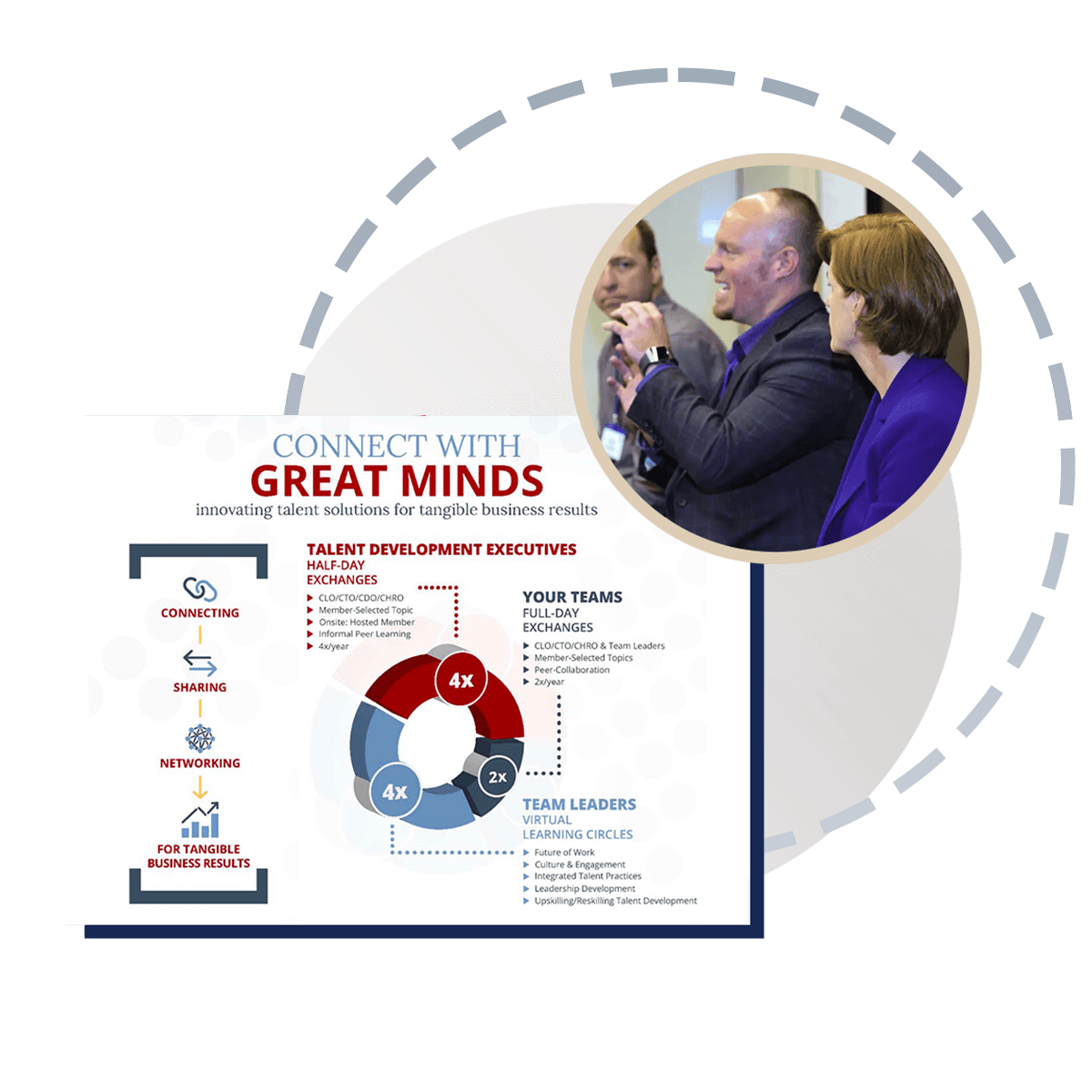
This was a live, in-person working exchange. No virtual components. All dialogue drawn from the spoken transcript.
Who helped move the work forward
Cecilia Lillegard, Jim Orheim, and Amanda Baker brought this working exchange to life at the Milwaukee Talent Development Conference. Cecilia and Jim co-facilitated the design charrette, keeping the sprint moving while drawing out voices from across the room. Amanda Baker was listed on the agenda and contributed to the collaborative arc of the discussion. The practitioners who filled the tables — people leaders and talent development professionals from across the Milwaukee area — drove the real output: generating, clustering, prioritizing, and stress-testing skill priorities against what they're actually navigating in their organizations today.
Catching the weak signals
The charrette opened with a provocation: imagine it's 2028. Some people are thriving with AI embedded in their daily work. Others are struggling. What's the skill gap between them?
What surfaced wasn't what most expected.
Every table independently prioritized human and cognitive capabilities — adaptability, critical thinking, emotional intelligence, business acumen, coaching. Nobody's top three touched tool proficiency or technical training. That convergence, unrehearsed and uncoordinated, is itself a weak signal worth paying attention to.
"These are the human skills that are going to always keep you ahead of AI." — Jim Orheim, Marquette University
The signal isn't that technical skills don't matter. It's that a room of experienced talent leaders, asked to look two to three years out, reached past the obvious answer and landed on something harder to build and easier to neglect. If your current workforce readiness investment is weighted toward tool training, that gap deserves a harder look.
Designing just-in-time readiness
One of the sharpest tensions in the discussion wasn't about what skills to build. It was about when and how.
The room named a real implementation problem: in-the-flow-of-work learning — long considered the gold standard — breaks down when the tool itself slows performance during the learning curve. Workers under delivery pressure can't also be building new AI capabilities on the same clock.
"The only way to get better is to block time specifically to improve your AI skills." — Participant
That's not a personal productivity tip. It's an organizational design decision. Protected practice time, separated from delivery pressure, is the structural condition that makes just-in-time readiness actually work. Without it, adoption becomes performance theater — high token use, low quality output, and a workforce that looks like it's moving forward while the underlying capability stays flat.
The pre/post mortem framework surfaced as a lightweight intervention worth testing: before any AI-assisted workflow goes live, force the team to name what could go wrong. After, debrief what worked and what didn't. It's low-cost, builds judgment, and creates the feedback loops that formal training programs rarely do.
Balancing risk tradeoffs
The most honest moment in the room came when a participant named what many talent leaders are quietly sitting with but not saying out loud.
"Are we pushing everyone to use AI? Or are we going to be more strategic?" — Nick Allen, CNA Insurance.
The context mattered. Nick raised the concern alongside evidence that doctors lose diagnostic accuracy when over-reliant on AI-assisted tools — and that workers who outsource core tasks to AI risk losing the underlying skill entirely. The question wasn't anti-AI. It was a leadership judgment call: which skills require active human practice to stay sharp, and are we protecting space for that practice — or optimizing it away?
The room didn't have a clean answer. But the practitioners who sat with the question longest arrived at a useful frame: not everyone in the organization needs to experiment with AI simultaneously. Structured pilots with deliberate feedback loops produce better capability outcomes than organization-wide rollouts that ask everyone to learn in public, under pressure, without guardrails.
The risk of inertia is real. So is the risk of building a workforce that's technically capable of using AI tools but has lost the judgment to know when not to.
What to try next
Three moves people leaders in the room identified as testable quickly — with early evidence signals:
- Map your capability exposure before you build anything. Pull your top five roles. For each one, ask: what does this person need to be able to do well in 18 months that they can't do today? If the answer is primarily technical, pressure-test that assumption against what surfaced in this room. The weak signal may be somewhere else.
- Run a pre-mortem on your next AI workflow decision. Before any new tool, process, or AI-assisted workflow goes live, block 30 minutes with your team to name what could go wrong. Not as a risk log — as a judgment-building practice. It develops the critical thinking and discernment the room identified as non-negotiable for 2028 readiness.
- Protect deliberate practice time at the team level. Don't wait for an L&D program. Identify one hour per week — team-wide, not individually opted-in — where people practice AI skills without delivery pressure attached. Track quality of output, not volume of usage. Slop going in produces slop coming out, and that pattern is already more widespread than most organizations are measuring.
Bring the work forward
If your organization is sitting with any version of this — unsure which capabilities to build now, caught between tool adoption pressure and program overbuilding, or trying to close a readiness gap before it becomes a performance gap — bring it into the ELE community.
Share the challenge, compare signals with trusted peers, and leave with practical next moves you can use.
Submit My Challenge Now: https://www.ele.llc/faqs/share-top-of-mind-talent-challenges