"The timing of the delivery usually doesn't match the time of the need." — Anton Maletich, Alter Domus
Most leadership development programs aren't failing because the content is wrong. They're failing because the moment of delivery is disconnected from the moment leadership is actually tested. People leaders came to this live in-person working exchange wrestling with a concrete problem: how do you move manager development out of the classroom and into the friction points where decisions are made, conversations go sideways, and judgment is required right now — not next quarter?
The work isn't stuck for lack of content. It's stuck because the dominant model is built around cohort schedules, not leader readiness.
Leaders in the conversation
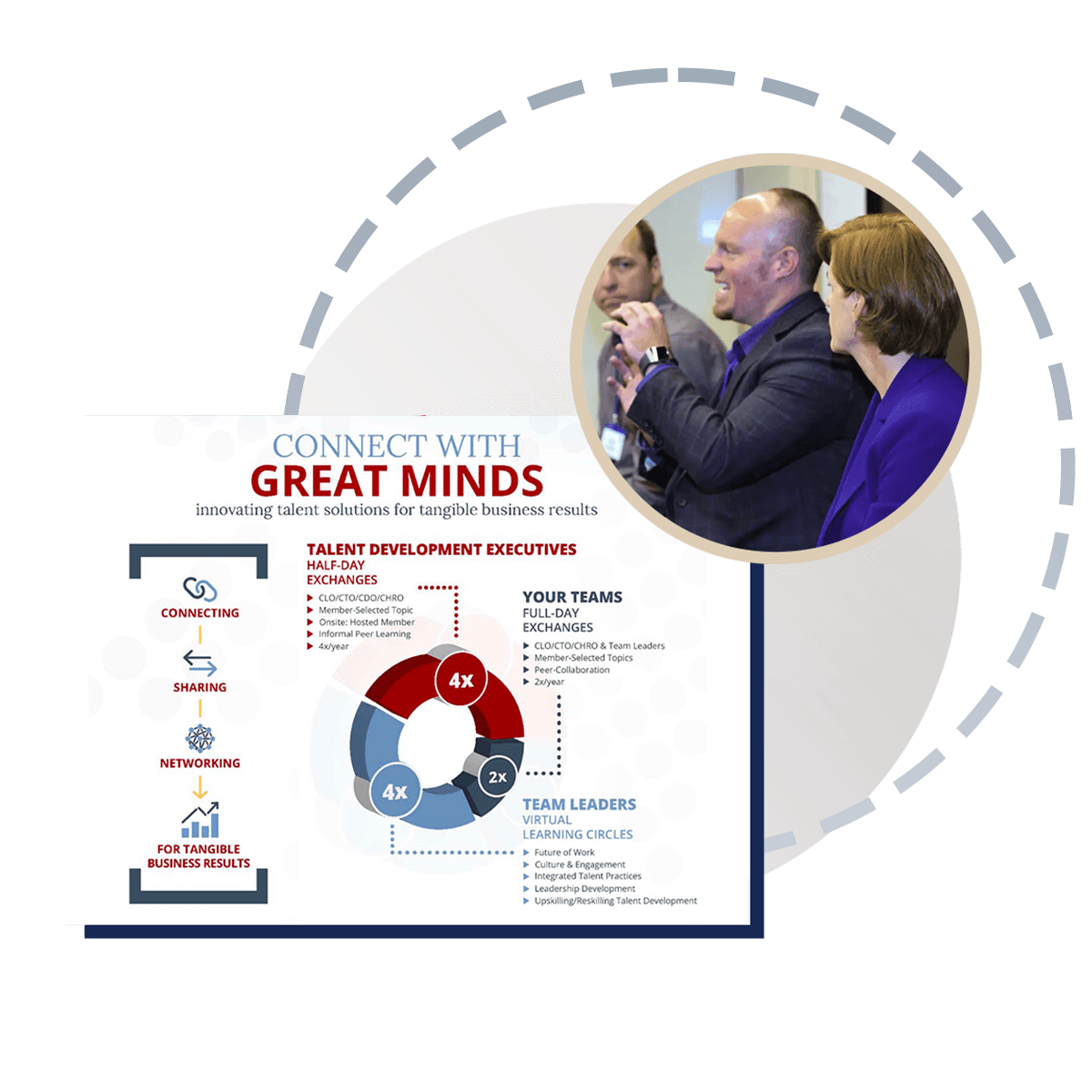
This working exchange brought together Anton Maletich (Alter Domus), Chris Olson (Scout), and Marty Murrillo (Precisely) as co-facilitators — each bringing a different lens from L&D practice, AI product development, and organizational leadership. The real movement in the room came from a genuine three-way exchange between their perspectives and the practitioners around them, not from a single presenter at the front.
The gap isn't knowledge. It's timing.
The room named this fast and kept returning to it. A manager who completed a situational leadership program in May and then faced a real performance situation in October doesn't have a knowledge problem. They have a retrieval problem — because the learning didn't happen anywhere near the work.
One director Anton cited named it plainly:
"I don't know what I'm supposed to do now that we have AI." — Anton Maletich, quoting a director.
That's not a training gap. That's a leader standing at a decision point with nothing in reach. The signal in the room: no amount of better curriculum solves a proximity problem. Development has to move closer to the moment — or it doesn't move at all.
AI as a coaching layer, not a course replacement
The most concrete proof point came from Anton's own team. He hired someone — Jesse — on day one with explicit ownership of building, managing, and improving an AI-powered onboarding agent for sellers. No committee. No pilot. Real accountability from the start.
What happened next wasn't planned:
"The unexpected value is the frontline manager learns from the AI's feedback to their sales rep." — Marty Murrillo, Precisely
The managers watching the agent deliver feedback to new hires started picking up coaching behaviors themselves. The development wasn't programmed into the system. It emerged from proximity to real work. That's a different model entirely — and it suggests AI is most powerful not when deployed as a training tool, but when embedded where the work is already happening.
The identity problem underneath the skills problem
A practitioner in the room put her finger on something the discussion had been circling:
"I didn't get into leadership to lead a thing. I came into leadership because I wanted to help people." — Participant
Leaders who built their identity around developing people are now being asked to manage agents, interpret AI outputs, and make decisions with incomplete data in accelerating timeframes. That shift isn't just a competency update. For many, it's a loss — and until development programs name that loss directly, technical enablement lands on frozen ground.
The discussion pushed further: the resistance people leaders see in their managers often isn't ignorance or laziness. It's a behavior that's still serving them somehow — reducing anxiety, avoiding risk, keeping the peace with the people above them. Coaching through that requires getting curious about what the resistance is protecting, not just training around it.
The moment of need is the hard part
Anton closed with the tension that no tool rollout has solved yet:
"If they have to remember, 'I can go get this to help me,' they never will." — Anton Maletich, Alter Domus
A manager in a heightened state — feeling attacked, blindsided, or under pressure — is not going to stop and search for a resource. The development that reaches them is the development that's already wired into their workflow. That's not an argument against good content. It's an argument for radical proximity: the right prompt, the right simulation, the right reflection question — available exactly when the situation is active, not after it's resolved.
What to try next
- Map your curriculum against your last 10 high-stakes manager moments. Pull the actual situations your managers faced in the past 90 days — performance conversations, AI adoption friction, team conflict, handoff failures. Put your current program next to that list. If the material doesn't show up in those moments, that's your redesign brief. Early evidence signal: managers can name a recent situation where they wished they'd had something in reach.
- Build one just-in-time prompt for a friction point you know is coming. Pick a specific, recurring situation your managers face — a difficult conversation, a handoff under pressure, an underperformer who isn't moving. Build a custom AI prompt setup they can reach for in the moment, not in preparation for a cohort. Keep it short enough to use in five minutes. Early evidence signal: a manager uses it once without being reminded.
- Assign real agent ownership to someone on your team — as a job, not a project. Give one person explicit accountability for building, managing, and improving an AI tool that touches real workflow. Not a pilot. Not a committee. One person, clear ownership, day one. Early evidence signal: they come back with something you didn't design and it's better than what you built.
Bring this work into the community
If this connects to real work you are trying to move forward — managers who can't reach their development when it matters, AI tools that aren't making it into the flow of work, or leaders navigating an identity shift they weren't prepared for — bring it into the ELE community. Share the challenge, compare signals with trusted peers, and leave with practical next moves you can use.
Submit My Challenge Now: https://www.ele.llc/faqs/share-top-of-mind-talent-challenges