Session Focus: Navigating the Journey to Skill Mastery: Assess, Practice, Validate
In the modern corporate landscape, upskilling and ensuring job readiness is no longer linear. Today's leading organizations are asking three pivotal questions:
- Does the workforce possess the necessary skills for their respective jobs?
- Can these employees effectively apply these skills in real-time, on-the-job scenarios?
- And perhaps most importantly, can the application of this skill be tangibly validated?
Aligning these inquiries with organizational strategies means connecting each question to specific business objectives:
- Recruiting: For external candidates, validation becomes paramount. Can the prospective candidate truly perform the tasks associated with the job role? Are their professed skills genuine, and can they be substantiated?
- Talent Management: For internal candidates, especially those eyed for promotions or role transitions, the key is again validation. Do these employees, familiar though they may be with the organizational culture, genuinely possess the capabilities to take on new responsibilities?
- Learning & Development: Here, assessment takes the lead. Before embarking on development initiatives, one must accurately gauge existing skill levels. What are the areas of proficiency, and where do gaps exist that require targeted development?
- Performance-based Skill Building & Validation: The Modern Approach
Traditional learning often remains procedure-oriented, with a focus on rote techniques. However, the future of skill-building lies in a performance-based approach. This strategy:
- Advocates for deep learning, emphasizing problem-solving and skill reinforcement over mere information retention.
- Shifts the focus to scenarios and real-world problems rather than abstract concepts. This problem-centered methodology ensures that learning mirrors actual job tasks.
- Provides employees with a conducive environment to practice and experiment. By offering a safe space, employees can explore solutions, make mistakes, and, crucially, "figure it out" without fearing real-world repercussions.
- Strongly encourages experiential learning. The age-old adage of "learn by doing" is more relevant now than ever, ensuring skills are acquired and deeply ingrained.
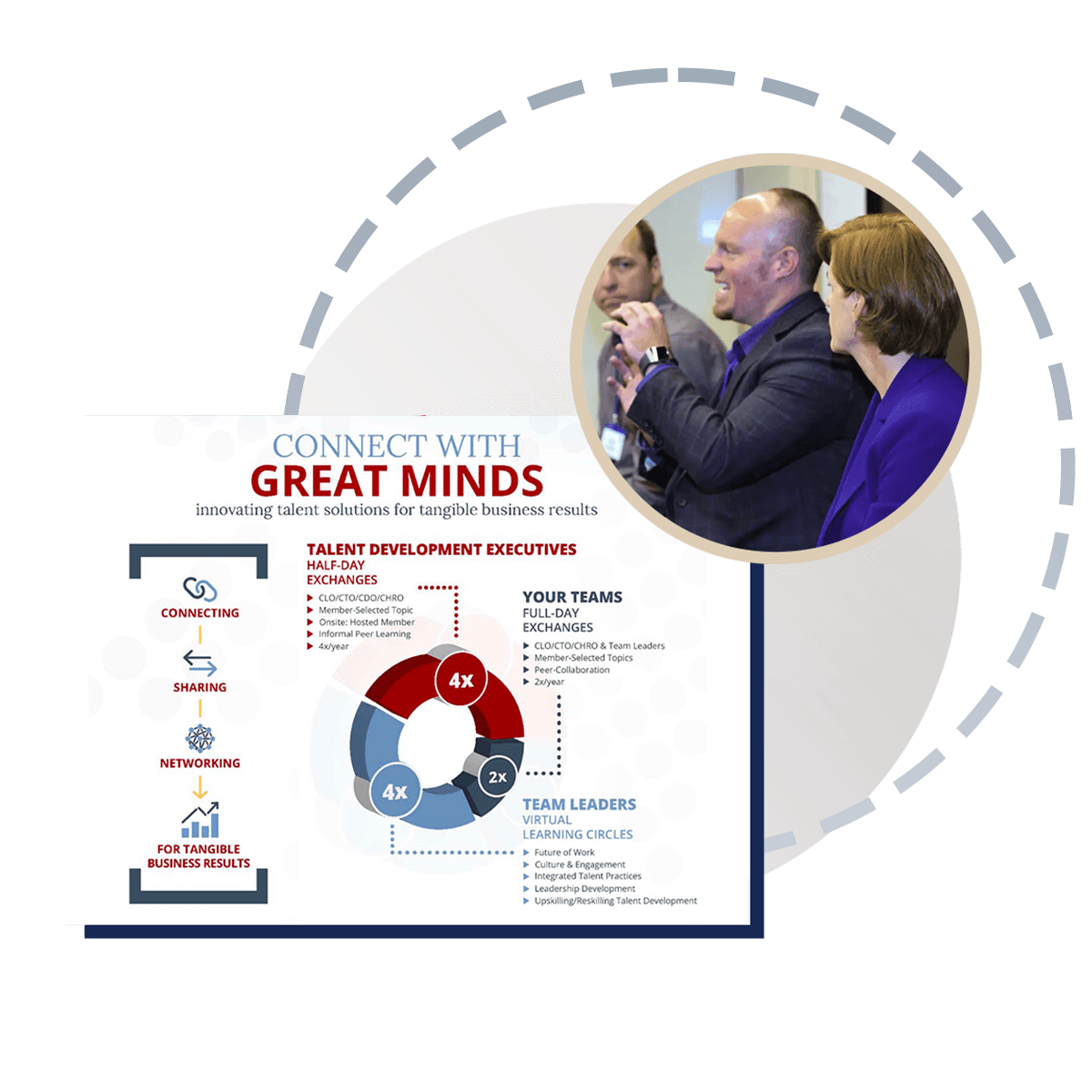
ELE produces this Learning Circle:
Reskilling Talent Development.
ELE's Idea Exchange: Collaborate online with your peers.