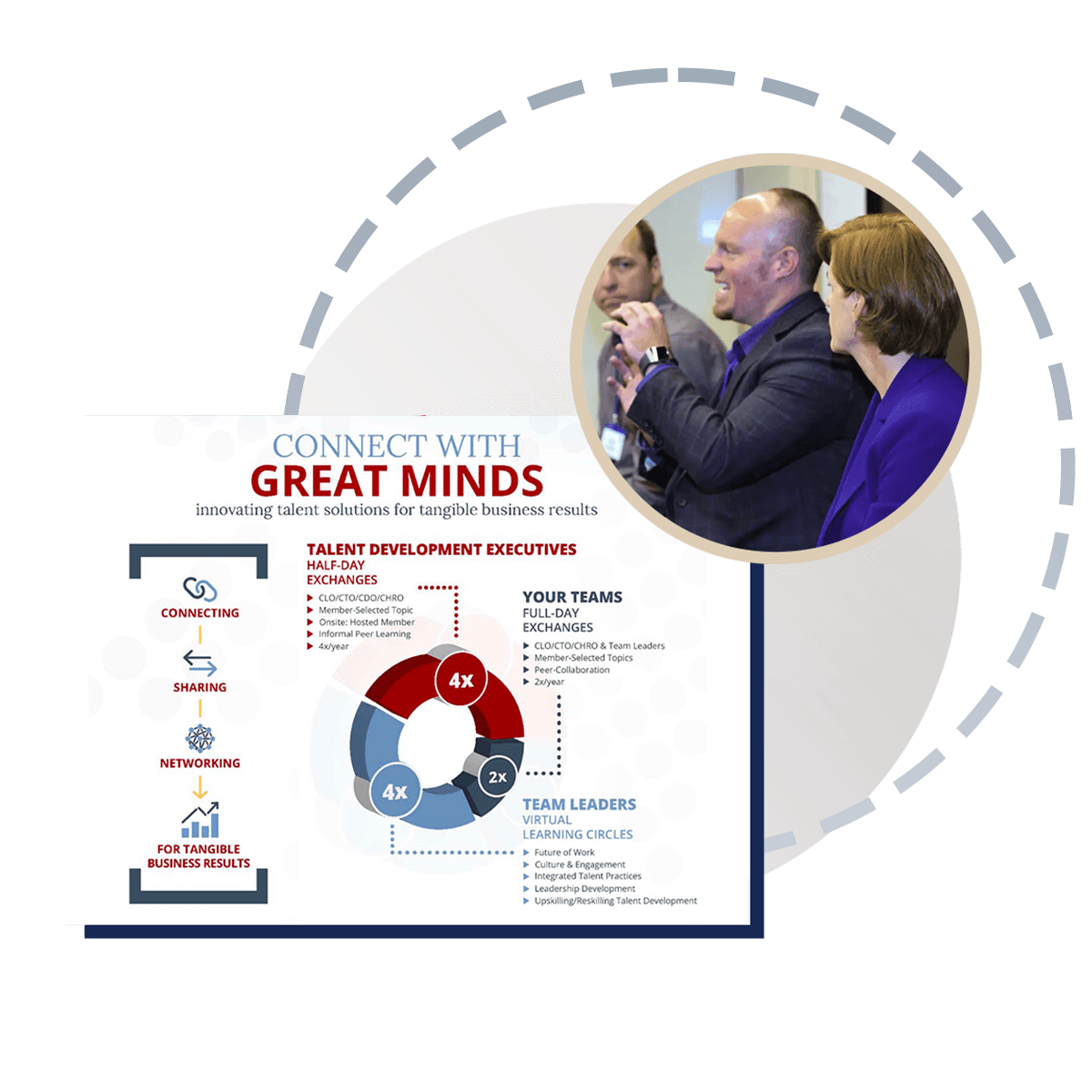
This highlight video is from April 09, 2026 session ✨ AI Practical Lab: Framing the Why — Leadership Development for AI at Scale
"Senior leaders are not crafting the why. So people aren't really being expected to use it to drive performance." — Nicole DeFalco, Upsurge Advisors
The business problem hiding inside your AI rollout
Most organizations have launched AI tools. Fewer have launched leaders who know how to use them.
That's the gap this live interactive discussion set out to close. AI adoption isn't stalling because employees don't have access to tools. It's stalling because senior leaders haven't framed the business case — and without that, frontline managers are left saying, essentially, you've got the tool, do the best you can. The result? Fragmented experimentation. Inconsistent use. No meaningful shift in how decisions get made or work gets done.
Who was in the room: Senior HR, L&D, and business leaders including Nicole DeFalco (Upsurge Advisors), Anton Maletich (Alter Domus), and Marty Murrillo (Precisely), alongside a cross-section of ELE members spanning healthcare, financial services, manufacturing, and consulting.
It's not an adoption problem. It's a leadership framing problem.
One participant described it clearly: her organization rolled out an AI tool with no communication, no positioning, no guardrails, and no follow-up — just access. Some people dove in. Most didn't touch it. What looked like an adoption problem was actually an absence of leadership direction.
This pattern showed up in real data, too. At one enterprise organization with thousands of employees, a small fraction — roughly the tech-forward early adopters — were responsible for the overwhelming majority of AI activity. Agents were being built in silos, some redundant, some ungoverned.
"The agent marketplace is now the nightmare that the LMS has been. We've just replaced the LMS with an agent marketplace." — Nicole DeFalco
The tools proliferated. The strategy didn't.
AI output isn't neutral — and neither is your judgment
The sharpest skeptic moment came when the group interrogated what AI actually produces when leaders don't think critically about the output.
"The outputs aren't wrong, but they aren't really right. It can generate noise in the system. You really have to build in hand-holds for you to both leverage AND grow your wisdom." — Matt Donovan, GP Strategies
The risk isn't just irrelevant output. It's output that looks credible enough to ship — polished, complete, well-formatted — with none of the performance-tied behaviors or measurable outcomes underneath. It looks like progress. It isn't.
"It can make you look better than you are, and you don't really know." — Dirk Tussing, ELE
The CRIT Model: From assistant to thought partner
We live-tested Marty Murrillo's demonstration of the CRIT Model (Context, Role, Interview, Task). The breakthrough? The Interview step. By forcing the AI to ask us questions before generating an answer, we surface blind spots and pressure-test assumptions.
 The CRIT Model for AI-driven leadership, from Geoff Woods. (Credit: Google Gemini Banana)
The insight wasn't about the tool itself — it was about leadership capability. If a leader can't answer the AI's interview questions, that gap is the actual business problem to solve.
A moment that mattered
When AI pushed back on a vague prompt — asking the group to name a specific business outcome, not just "improve productivity" — the room landed on something honest: most organizations don't actually know what AI-driven performance looks like in their context.
Dirk Tussing put it plainly: "If we just ask for general stuff, we're gonna get general stuff back."
The CRIT interview step didn't just improve the AI output. It exposed the strategic ambiguity that was already there.
What to try next
Start with one decision, not one tool. Have senior leaders identify a single business decision — something that already happens this quarter — where AI will be used to inform or accelerate it. Name the outcome. Define what "better" looks like before anyone touches a prompt.
Run the CRIT interview on yourself. Before building any AI-enabled leadership development, use the CRIT model's Interview step with a real organizational challenge. If the senior leaders in the room can't answer the clarifying questions, that's your curriculum.
Baseline before you build. Christopher Lind's challenge to the group: if you want to improve productivity, what's your baseline today? Without it, any change is just a gut feeling. Ask your internal client to name the data they have — and flag what's missing.
If any of these insights resonate — and you've got a top-of-mind talent business problem you'd like the ELE community to work on — send it our way. Members can submit their business challenge here: Submit My Business Challenge Now