Put Your Top-of-Mind Business Challenge in Front of the Right People

The starting line for a real conversation with experienced talent leaders.


Put your challenge into the Design Charrette pipeline.
We start with live peer-working sessions that move from
Idea Exchange discussions to featured Insights.

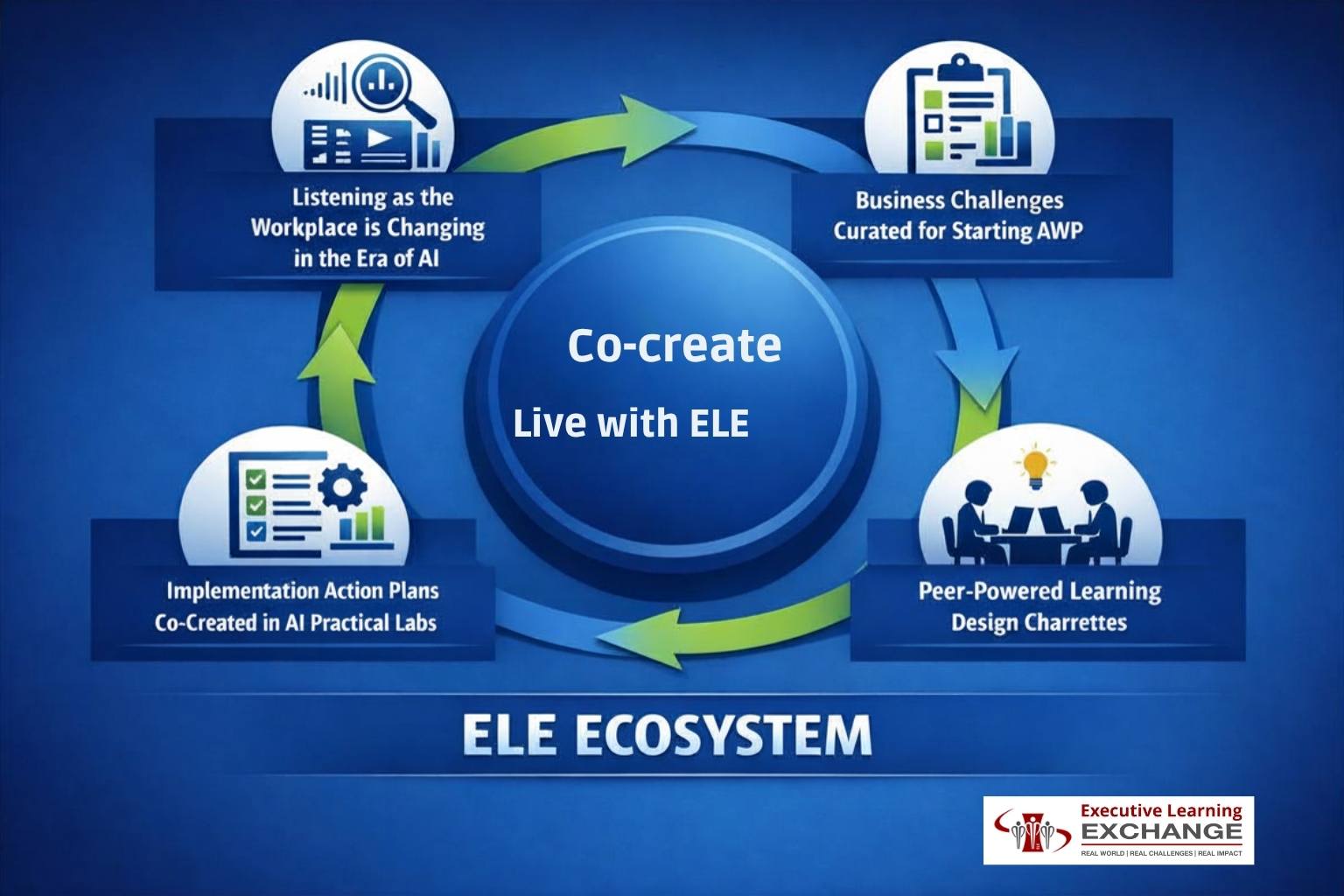
Your challenge fuels the ecosystem. When you submit a business issue, it enters our Design Charrette pipeline—a workflow designed to move from raw problems to peer-vetted experiments.

See the highlights and what's produced: Watch how experienced talent leaders live-map a real-world AI challenge, then join the Idea Exchange to see the ongoing peer-to-peer collaboration.

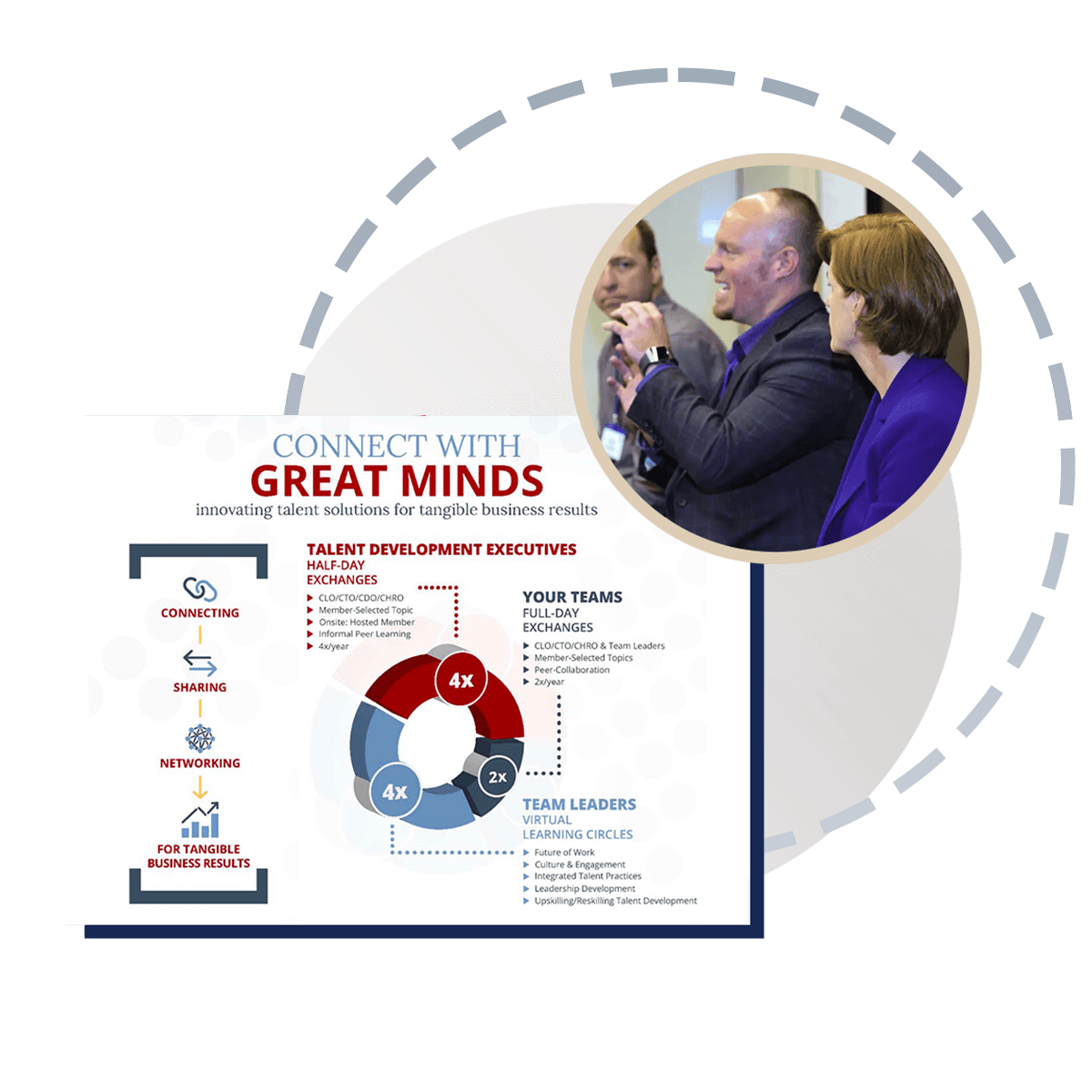
Three-step ELE model

Your challenge fuels the ecosystem. When you submit a business issue, it enters our Design Charrette pipeline—a workflow designed to move from raw problems to peer-vetted experiments.

See the highlights and what's produced: Watch how experienced talent leaders live-map a real-world AI challenge, then join the Idea Exchange to see the ongoing peer-to-peer collaboration.

Share your most pressing issue—and we’ll help turn it into a peer-powered working conversation.

Examples include:

  • AI adoption stalling in the flow of work
  • Managers overwhelmed by competing priorities
  • Strategy shifting faster than teams can execute
  • Critical skill gaps appearing mid-work
  • Cross-team collaboration slowing delivery

The 2026 Shift

This 2026 shift ensures ELE remains a place where experienced leaders do more than listen—they work through real problems together.

They work together on real problems, strengthening judgment through collaboration and building confidence by testing ideas with trusted peers. In an era increasingly shaped by AI, leaders don’t just need more information—they need better conversations about real work.



FAQ Banner Image

Authors

Dirk Tussing
Yolanda Mangram
Angelica Stilling

    What kinds of challenges should members submit?

    View

    Members are encouraged to submit top‑of‑mind, in‑practice challenges where peer insight can reframe and simplify. Examples include:

    • AI Adoption Stalls: You have the tools, but managers are overwhelmed and unsure how to lead the shift.

    • The Reskilling Gap: You know where the workforce needs to go, but the training isn't sticking to "real work."

    • Strategy vs. Execution: Your leadership team is moving fast, but the teams on the ground are hitting friction.

    • Leadership Readiness: Moving beyond "succession lists" to actually preparing leaders for 2026 disruptions.

    • Operating Model Friction: Your current structure is slowing down decisions in a high-uncertainty market.

    If the challenge is timely, complex, and benefits from peer insight, it is a strong candidate for upcoming ELE programming.

    How will submitted challenges be used?

    View

    Your submission moves from a private challenge to a peer-vetted insight. We review every challenge to determine the best "working track" for the community, which may include:

    • Design Charrettes: A focused, small-group session where peers and AI help you map out a practical next step.

    • AI Practical Labs: A hands-on workspace where we apply tools like Copilot directly to your specific talent or workflow constraints.

    • Insights & Idea Exchange: We synthesize the best ideas from these sessions into actionable takeaways and recordings for the broader community.

    Not every submission becomes a public session, but every challenge helps ELE identify the most urgent "real work" the community needs to solve together.

    How can members submit a challenge for consideration?

    View

    Submitting a challenge is the first step in our design process.

    Members and qualified prospects can start the intake using the ELE Submission Form. To ensure the conversation is productive, the form helps you frame:

    • The core challenge you are navigating right now.

    • The business context (Why is this a priority today?).

    • The desired peer input (The specific "reframe" or "next move" you need).

    Submit Your Challenge

    Once submitted, your challenge informs our upcoming Design Charrettes and AI Practical Labs. The best way to move your challenge forward is to join the next live session, where we co-create next steps and testable experiments in real time.

    What is an ELE Design Charrette?

    View

    Borrowed from architecture, a Design Charrette is a focused, high-energy workshop used to solve complex problems quickly.

    Introduced by Alaska Fu, ELE’s Experience Designer, these are 50–90 minute peer-powered conversations where we move a specific member challenge from "stuck" to "testable."

    Design Charrettes are:

    • Small by design: To ensure every voice contributes to the solution.

    • Structured, but conversational: We follow a workflow, not a script.

    • Action-oriented: You leave with a practical next step, not just "more to think about."

    How it works: We run each challenge through our 4-Step Workflow (Clarify, Co-create, Customize, Commit). This ensures the group identifies the real business problem—preventing "solution-first" thinking—before using AI and peer insight to map out a path forward.

    From Ideation to Action

    At the end of every Design Charrette, we use the Action Planning Worksheet to distill rapid peer-insight into a testable experiment. Watch Aaron Olson explain how this tool helps leaders move from "solving for symptoms" to "solving for the business."

    See the Design Charrette workflow in action

    Resource: ELE’s Design Charrette Action Planning Worksheet — adapted from Aaron Olson’s Strategy & Change (Wiley).-- [Open Editable PDF]

    What is an ELE Innovation Sprint?

    View

    An ELE Innovation Sprint is a time-boxed, community-powered engine used to tackle systemic challenges that require reframing complexity into simple using the stuff we know.

    Unlike public sessions, Sprints are private, small-group cohorts (6-8 members) that collaborate semi-synchronously. While the broader community sees the final results, the raw building and testing happen privately within the Idea Exchange.

    Innovation Sprints are used for:

    • Reskilling at Scale: Moving beyond theory to build practical pathways for shifting workers into new roles.

    • AI-Driven Leaders: Shifting from operational overwhelm to strategic clarity by having Senior Executives own AI as a Thought Partner to frame the "Why" and align enterprise strategy with measurable business value.

    • AI-Coaching: Building practical frameworks where AI acts as a performance multiplier for managers and their teams in the moment of need.

    • Cultural Transformation: Creating "testable experiments" for high-performing environments.

    The Outcome:

    For organizations that need to move faster, ELE Solutions Exchange can be hired to build and implement these custom frameworks directly into your enterprise workflow.

    How do we move from a prototype to enterprise results?

    View

    The Outcome: Impact Pathways

    While an Innovation Sprint focuses on co-creating the "right" solution with peers, Impact Pathways are about the "last mile" of execution. For organizations that need to move faster, ELE Solutions Exchange can be hired to take a Sprint prototype and turn it into a certified implementation.

    Impact Pathways include:

    • Structured Rollout: A step-by-step blueprint with built-in accountability and milestones.

    • Employee Engagement: Interactive frameworks that ensure the solution is adopted by the workforce, not just filed away by leadership.

    • Measurable Accountability: Custom dashboards and tracking to ensure the rollout delivers measurable results.

    This ensures that the complexity we've reframed actually stays simple when it hits your unique enterprise workflow.

    How is this different from traditional ELE events?

    View

    Horizontal graphic featuring Seurat's A Sunday on La Grande Jatte with text overlays for Confidence, Capability, and Clarity for the Executive Learning Exchange Design Charrette. Moving from perspective-building to active co-creation.

    Traditional events are designed for perspective-building: you hear ideas, collect frameworks, and leave with new language. ELE Design Charrettes and Innovation Sprints are built for doing. We have moved away from static slide decks to a 4-Step Workflow that uses your real business problems as the engine:

    1. Clarify: Stripping away symptoms to find the real business problem.

    2. Co-create: Using peer expertise and AI to generate rapid options and reframes.

    3. Customize: Stress-testing those options against your specific constraints and operating model.

    4. Commit: Leaving with a testable experiment and a clear next move.

    The 2026 Shift: Instead of looking at a presentation, you are entering a "landscape" of possibilities. Our process is designed to prevent “solution-first” thinking—helping you confirm whether a challenge needs a talent solution, a workflow redesign, or a change in leadership focus before you invest.

    What is an ELE Local Meetup—and how does it connect to ELE programming?

    View

    Local Meetups are informal, in-person exchanges where leaders bring real business challenges to find blind spots with peers in their own city. They are designed as a space to step away from the screen and engage in high-value, face-to-face dialogue.

    • Surfacing the "Real Work": Meetups are gatherings of business leaders to have conversations on specific themes—like AI adoption friction or manager burnout. Connecting at a local level helps you talk through common hurdles, get fresh perspectives from other leaders, and build your trusted network of advisors.

    • Platform Supported: Think of these meetups as being "Powered by ELE." Our community directors support local metros so ELE handles the heavy lifting for back-office tasks, registration, and coordination.

    Current Active Hubs:
    You can find the next local gathering on our Design Charrette Event Experiences page.

    How does this connect to ELE’s history?

    View

    Think ELE, think CAPABILITY, CONFIDENCE & CLARITY. This evolution builds on ELE’s two-decade commitment to practical, peer-driven work. Since its founding at Baxter in 2002, ELE has existed to help leaders navigate the real-world complexities of talent and leadership.

      • Contribute and Build an ELEfolio (Capability): In the past, members attended; now, they document. By solving real-world problems in the Idea Exchange, you aren't just participating—you are building a personal portfolio of peer-vetted solutions and leadership outcomes.

      • Modernizing the Spirit of Collaboration (Clarity): Since 2002, ELE has evolved from a place where leaders primarily listen to a space where they co-create. We invite members to bring their most pressing in-practice challenges forward to strip away the noise and find the right path forward together.

      • Extending Beyond the Midwest (Confidence): Our roots are in Chicagoland, but the complexity of 2026 is global. We are scaling our Design Charrette Event Experiences to connect regional expertise to a national network of problem solvers, ensuring you can lead with certainty regardless of geography.


    Why is ELE making this shift now?

    View

    Think ELE, think CONFIDENCE & CLARITY. We are in an era of massive disruption. In the age of AI, information is everywhere, but judgment is rare. No single leader has all the answers, which is why the ELE community is moving toward an integrated, peer-powered model.

    • A Unique Peer-Power Capability: We are moving beyond networking to active navigation. This shift allows us to leverage our collective intelligence to build the new muscles and the confidence required to lead through AI-driven change.

    • Clarity Through Community: The complexity of 2026 requires more than a solo effort. Our Design Charrette Event Experiences help you identify blind spots and test new approaches in a high-trust environment, giving you the clarity to act before scaling ideas in your own organization.

    • Confidence Through Practical Evidence: ELE has always been about grounded, peer-vetted evidence. This shift moves the starting line into the business to capture real signals and engage in peer-learning. It supports the identity shift needed to become an AI Workforce Transformation Strategist—ensuring that when you make a move, it is backed by the shared experience and Insights of your peers.

    Retro-style two-panel illustration comparing an AI workforce transformation strategist driving performance, speed, and impact with an overwhelmed leader buried in paperwork under “program overload,” “slow rollouts,” and “launch another training.”

    What does “active contributing members” mean?

    View

    Think ELE, think CAPABILITY. An Active Contributing Member is a practitioner who moves beyond observation to help build the community's collective intelligence. This isn't a passive subscription; it is an engagement in real work.

    • Participation in Good Standing: Maintaining a current ELE user account and showing up for Design Charrette Event Experiences and Local Meetups.

    • Sharing the "Real Work": Bringing current, in-practice challenges to the table and helping peers find blind spots in theirs.

    • Building Your ELEfolio: Contributing to the Idea Exchange to help co-create solutions and testable experiments. This creates a documented track record of your growth as an AI Workforce Transformation Strategist.

    The Bottom Line: It’s not about having all the answers—it’s about contributing your experience to drive forward motion for yourself and the network.

ShareCopy