Many organizations track training completion rates and basic usage metrics, yet AI use often stalls quietly after the initial push. The real cost lies in what standard dashboards fail to capture.
Drawing on her work inside a financial services firm that had trained and equipped about 1,500 AI users and still asked why results lagged, this session uncovers the hidden signals that emerge post-training—from leadership behaviors and unspoken employee hesitations to new operational friction and unforeseen risks. For talent and learning leaders, recognizing these subtle indicators is essential to understanding whether AI is truly taking hold.
Led by Dr. Serena H. Huang, this keynote helps leaders look past surface-level usage metrics to the blind spots that decide whether AI changes the work.
What we heard
At a financial services firm that grew from 150 to 1,500 AI users, Serena traced stalled results to three blind spots: leaders who champion AI but rarely use it, work that stays the same with AI added on top, and systems so locked down that people turn to shadow AI. Teams with identical tools and training saw very different value, and the difference was whether they redesigned the process. Her ask for learning leaders: before ordering another round of training, ask what has changed now that you're using AI.
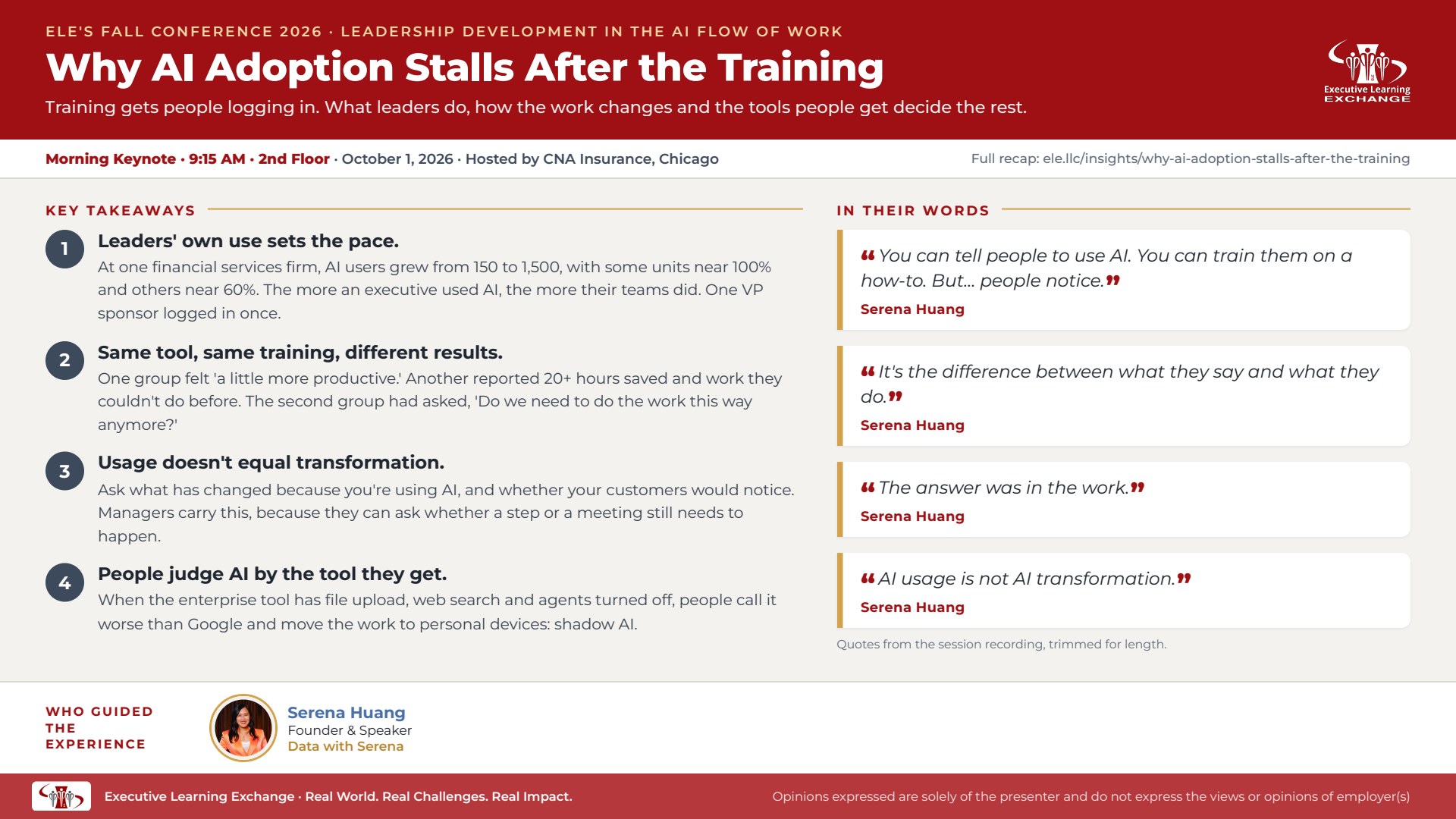
"…you can tell people to use AI, you can train them on how to, but if the person leading them is not using it and touching it, people know this."
Serena Huang
"…don't just ask how many people have taken AI training. Ask them this question, what has changed now that we're using AI?"
Serena Huang