While enterprise leaders have managed countless organizational transitions, AI transformation presents unique dynamics that challenge standard playbooks. Making AI change stick requires evaluating which classic change management principles remain effective and which must be adapted for exponential technology adoption.
This panel examines the intersection of change leadership, employee resistance, and learning and development strategy. By discussing real-world implementation, these leaders highlight what strategies hold firm, where flexible approaches are required, and how organizations can reframe their starting points to ensure lasting behavioral shift.
Moderated by Gretchen Hartke with Beth Zadik, Diana Anderson, and Fiona Paulius, this Executive Cohort Panel addresses critical questions surrounding adapted change management, emerging resistance patterns, and AI change that lasts.
What we heard
Beth compared AI change to moving to a city nobody chose: every routine has to be relearned, so effort and fear arrive before efficiency, and people will move at different speeds, from early builders to those who don't want to learn it at all. Diana treated resistance as information, asking whether it comes from fear, feeling left out, or missing information. Fiona's move was to ask what to stop, simplify or shift to self-service, and to put learning and development inside the teams automating workflows so the people side isn't forgotten.
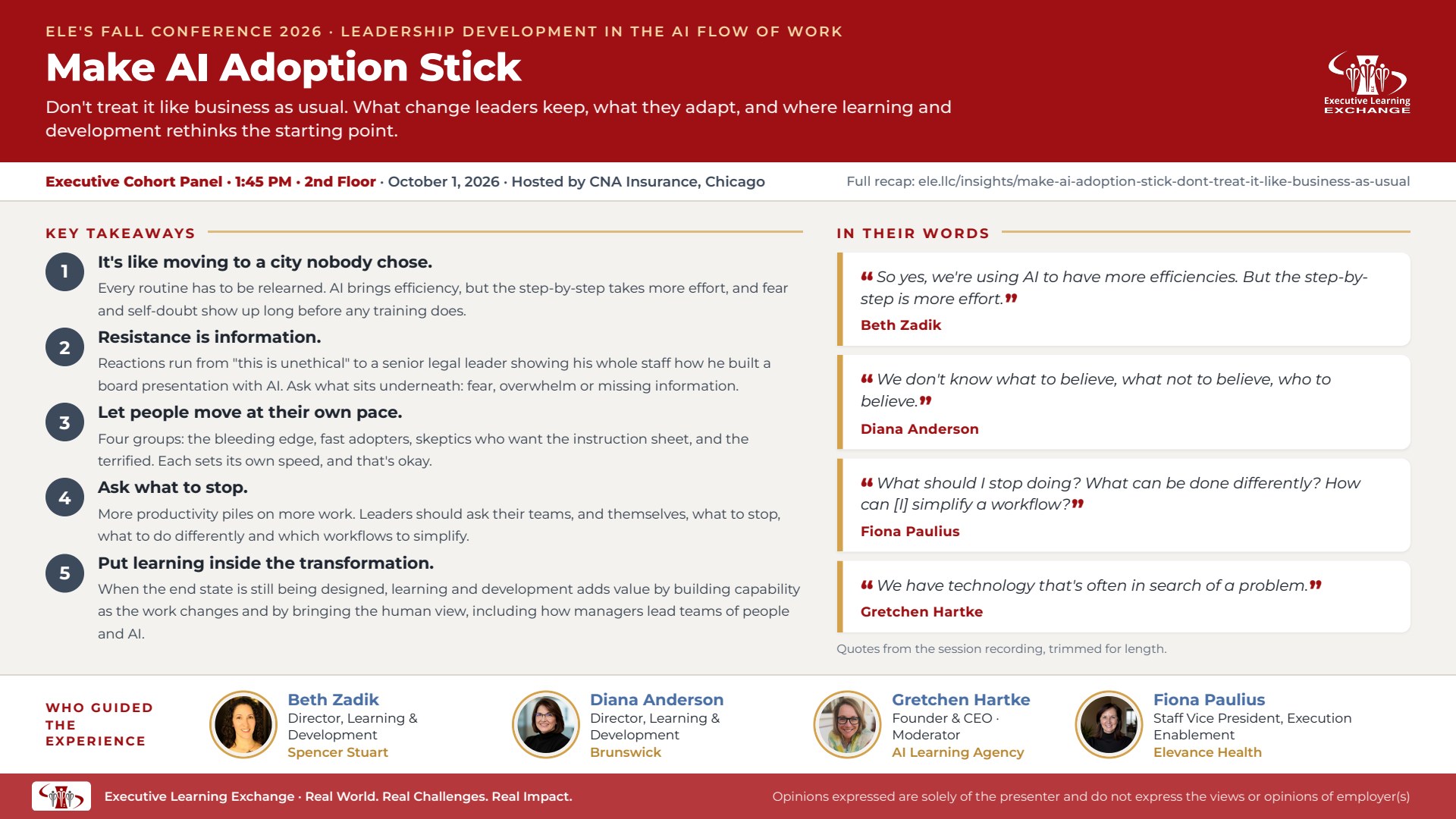
"Well, the change management of what has happened to all of our lives and our colleagues' lives just caused everyone to move cities. And these people did not ask to move cities."
Beth Zadik
"…I do think it's incumbent on all of us to ask those questions: what should I stop doing? What can be done differently?"
Fiona Paulius