As artificial intelligence integrates into daily operations faster than organizations can adapt, many leaders reflexively turn to new competency frameworks, reskilling programs, or structural reorganizations. Yet a more foundational question must be answered first: What human strengths remain truly irreplaceable?
Treating AI as an effortless shortcut risks quietly eroding critical human capabilities. Drawing on research regarding cognitive surrender from The Wharton School, enterprise leaders must identify and protect core human strengths—ensuring that rapid technological adoption enhances, rather than diminishes, human judgment and strategic thinking.
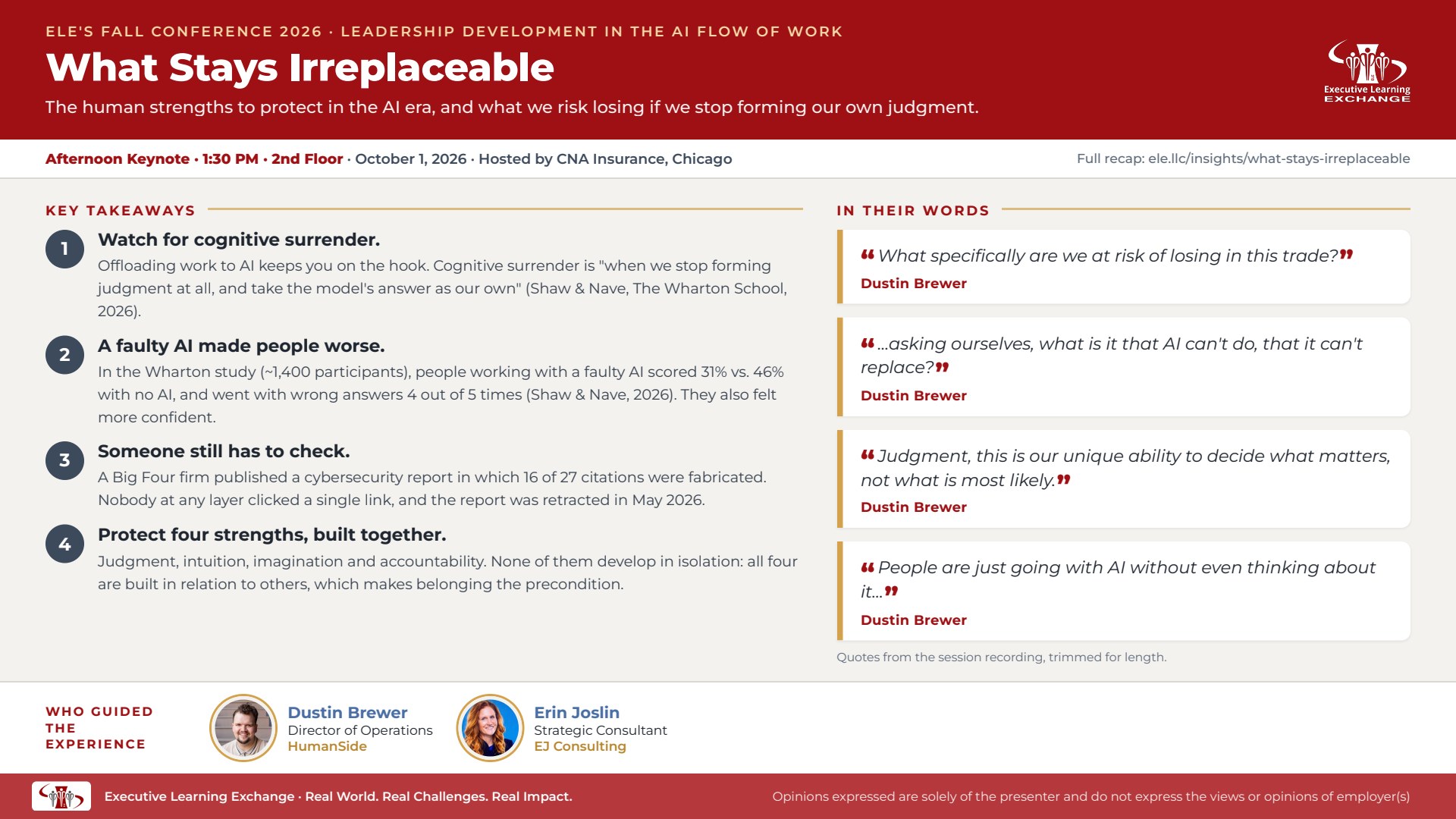
Led by Dustin Brewer and Erin Joslin, this keynote names four irreplaceable human strengths, giving leaders clear language and research-backed frameworks to safeguard human capability across their teams.
What we heard
Dustin separated cognitive offloading, where AI helps with the work and you're still on the hook, from cognitive surrender, where people take whatever AI gives them without thinking. He cited a Wharton study of 1,400 people: the group with an AI assistant rigged to be wrong half the time scored 31%, the group without AI scored 46%, and the AI group felt more confident. The strengths to protect are judgment, intuition, imagination and accountability, and they only form through feedback with other humans.
"Cognitive offloading is AI helps me with this, it works with me on it, and I'm still on the hook."
Dustin Brewer
"So judgment, this is our unique ability to decide what matters, not what is most likely. AI can tell us what's most probable."
Dustin Brewer