After years of broad AI experimentation, enterprise leaders face a critical shift: demonstrating tangible business value. As adoption grows and technology costs become visible, organizations must transition from widespread exploration to focused, high-impact investment.
This Design Charrette uses ELE’s Signals-to-Action framework to work through a realistic adoption scenario. Small peer groups evaluate existing workflows to determine what initiatives should scale, which efforts should stop, and how to navigate key strategic tradeoffs without scaling low-value activity.
Facilitated by Dustin Brewer, Gretchen Hartke, Anton Maletich, Patti Ouzounian, and Matt Sernaker, this Design Charrette equips leaders with clear priorities and a practical way to decide what to scale, change or stop.
What we heard
Tables sat on a fictional AI committee at an insurer spending nearly $1.4 million a year on AI, with 41% weekly usage against a 70% target and a course that hit 94% completion but changed no measurable behavior. One table would pull licenses back, charter a team to standardize underwriting and claims with AI, and ask other departments for a business case to regain access; another would keep the investment, require use backed by tools people want, and accept losing a resistant veteran. The shared lesson: set a baseline now, treat year one as year zero, and weigh license cost as an investment in people.
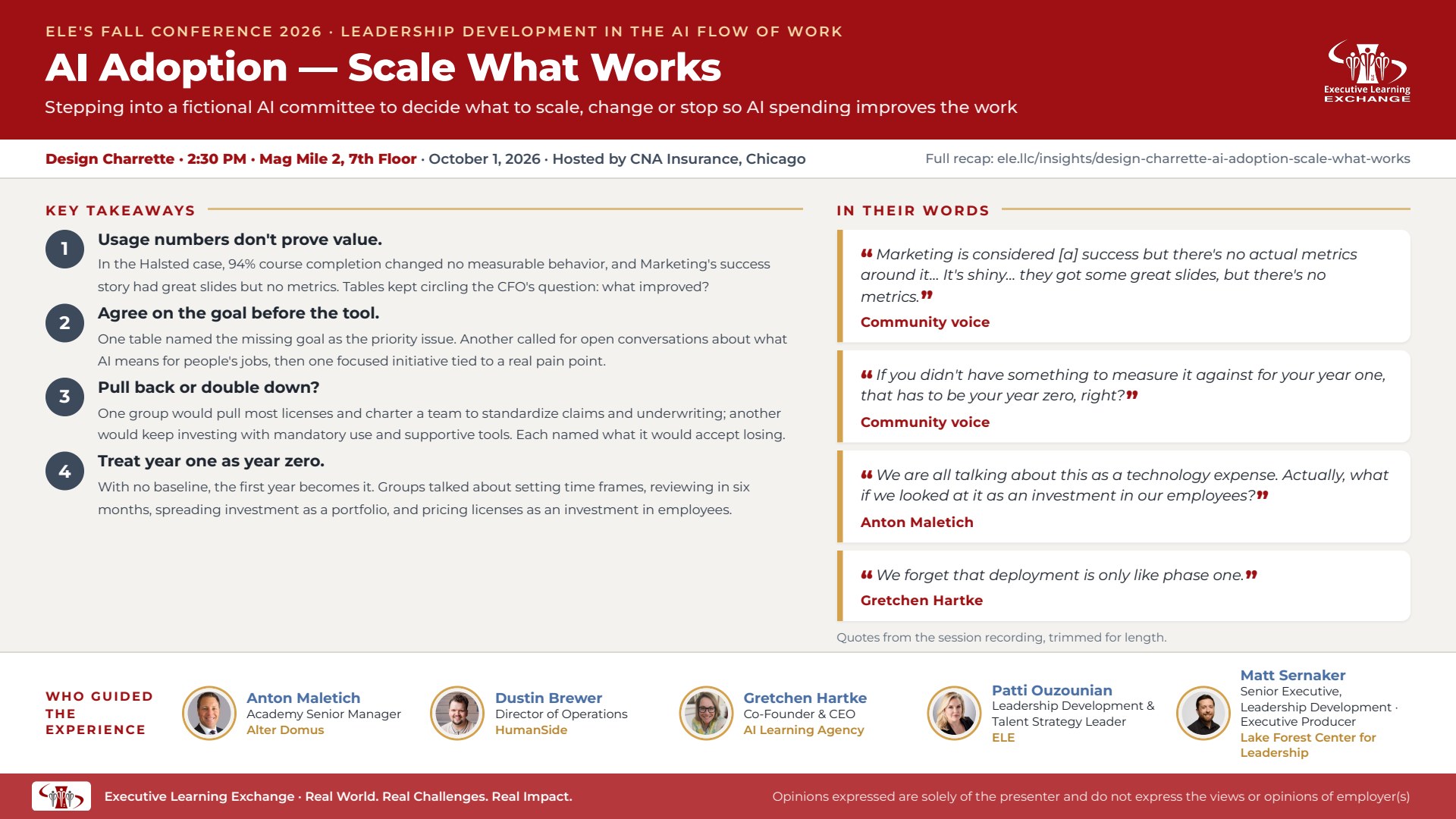
"I think that if you didn't have something to measure it against for your year one, that has to be your year zero, right?"
Community voice
"We are all talking about this as a technology expense. Actually, what if we looked at it as an investment in our employees?"
Community voice