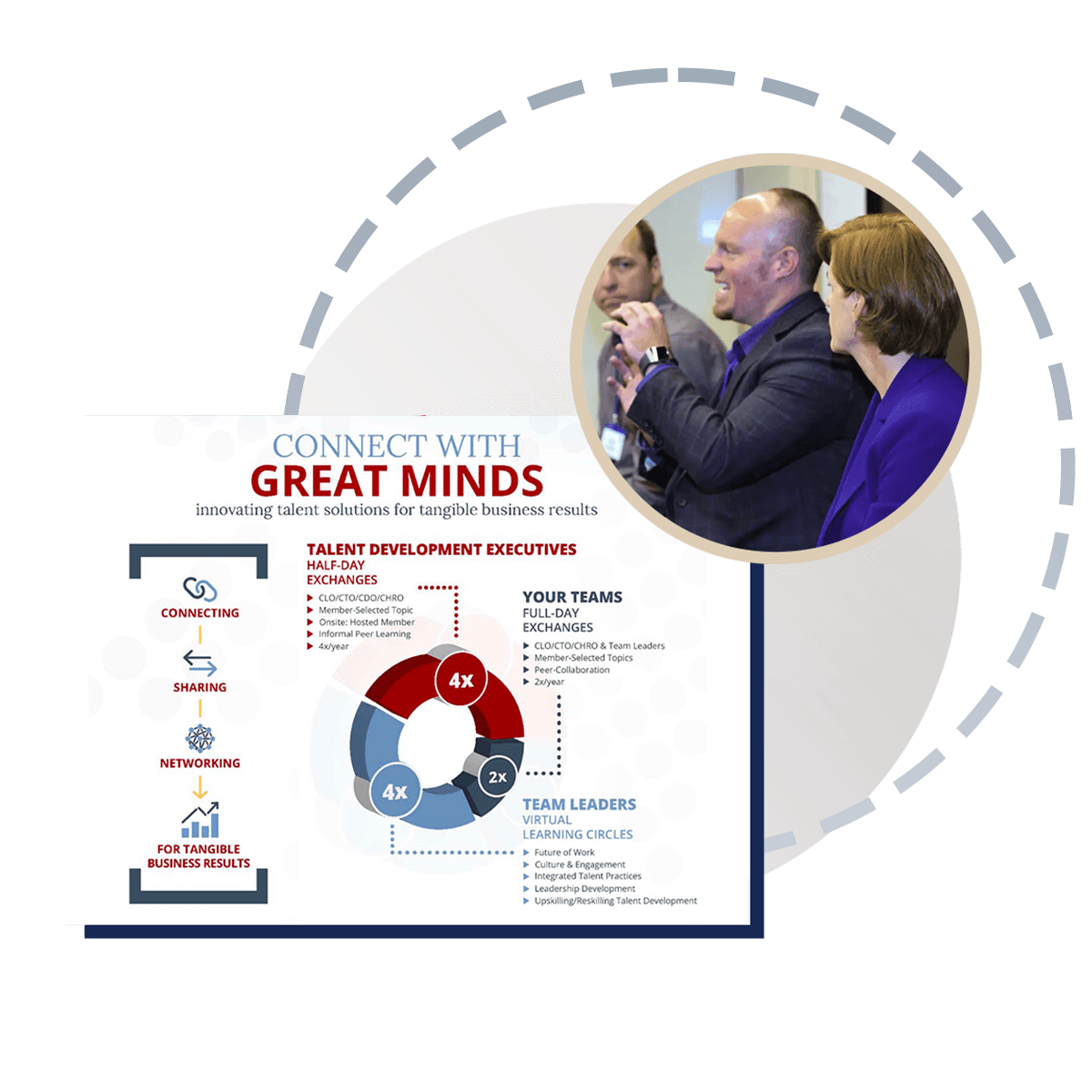
This highlight video is from the May 8, 2026 live discussion Design Charrette | AI Disruption = Career Opportunity.
"I want to go to where the puck's going to be, not where it is today." — Marty Murrillo, Precisely
The business problem
AI is rewriting where value gets created in L&D — and where it doesn't. Job descriptions now demand AI fluency, teams are shrinking, "spot AI projects" are popping up everywhere without anyone redesigning the underlying workflows, and senior talent leaders are getting whiplash. The live challenge in the room came from Audra Pinter (Discover/Capital One), who's been in transition and asked her peers how to upskill in AI — and quickly realized the question itself was a symptom of a bigger gap: L&D pros don't yet have a shared way to identify their unique value, redefine their roles for greater business impact, and navigate a job market reshaping in real time.
This was Part 1 of a series. What surfaced here feeds directly into the upcoming AI Practical Lab, where the room moves from "what should we try" to "what did we ship."
Who was in the room
Audra Pinter (Discover/Capital One), serving as the Internal Client who anchored the real-world business problem; Patti Ouzounian (ELE), serving as the AI Strategist who walked the room through the Signals-to-Action Planning Worksheet; co-facilitator DeB Lenchard (L&D Consultant); plus strong voices from Adrienne Guerrero (Positive Delta), Peter Hogaboam (CNA Insurance), Katie Stone (Global Talent Leaders), Marty Murrillo (Precisely), Mike Hoyt (Lake Forest Center for Leadership), David Scherer (Chicagoland Talent Leaders), and additional contributing members from the ELE community.
Chase the workflow, not the tool
The room kept landing on the same trap: companies are bolting AI onto existing processes without rethinking the work itself. Marty named it cleanly:
"They're trying to do these little spot AI projects, but they're not fixing the workflows." — Marty Murrillo
If your AI experimentation isn't surfacing workflow redesign questions — what handoffs disappear, what decisions move closer to the work, what new owners emerge — you're optimizing the wrong thing.
Don't become the in-house AI tutor
A real risk surfaced when Katie laid it out plainly:
"We have to avoid becoming just the AI training department for everyone." — Katie Stone
L&D's value isn't in being the help desk for prompt-writing. It's in building the conditions — culture, manager support, reinforcement — that make AI adoption stick across the business. Adrienne pushed it further: organizations are starting to believe AI can build learning without learning professionals. That's the strategic risk to name out loud, now.
Smart resistance is a leadership skill, not a brake
Peter reframed resistance as a discipline, drawing a sharp parallel to the outsourcing wave:
"You don't actually own it anymore, because it's out of your control." — Peter Hogaboam
When companies handed off operations decades ago, they lost the knowledge that let them own the process. AI agents quietly automating decisions carry the same structural risk. Smart resistance — knowing when to push back, when to slow down, when to keep humans in the loop — is how you keep ownership of the work.
Outcomes are the compass
Marty's "where the puck's going" landed because it gave the room a forward-looking filter. Don't chase the tool. Don't chase the role description. Start with the outcome you need, then work backward into where to build skills, where to experiment, and where to hold the line.
What to try next
- Pick one workflow this week, not one tool. Map a single high-friction decision in your work. Ask: what would change if AI sat in this loop? Early evidence: the conversation gets concrete fast, and you stop pitching "AI literacy" and start pitching workflow redesign.
- Audition, don't interview. Marty flagged a market signal in chat: interviews shifting to "auditions" showcasing AI skills. Whether hiring or being hired, build a 5-minute live demo of how you've used AI to change a real decision. Early evidence: the demo immediately separates "I read about AI" from "I work with AI."
- Bring one item of smart resistance to your next leadership meeting. Surface one AI decision that needs slowing down — not stopping. Early evidence: leaders start treating you as a strategic partner, not the AI evangelist.
What's next: Part 2 — the AI Practical Lab
The action plans surfaced today feed directly into the upcoming AI Practical Lab: AI Disruption = Career Opportunity, where the ELE community moves from action plan to build. Bring a colleague.
If any of these insights resonate—and you've got a top-of-mind talent business problem you'd like the ELE community to work on—send it our way.
Members can submit their challenge here: Submit My Challenge Now
Looking to turn these ideas into action? Access the Idea Exchange Post-chat for an updated Action Planning Worksheet.