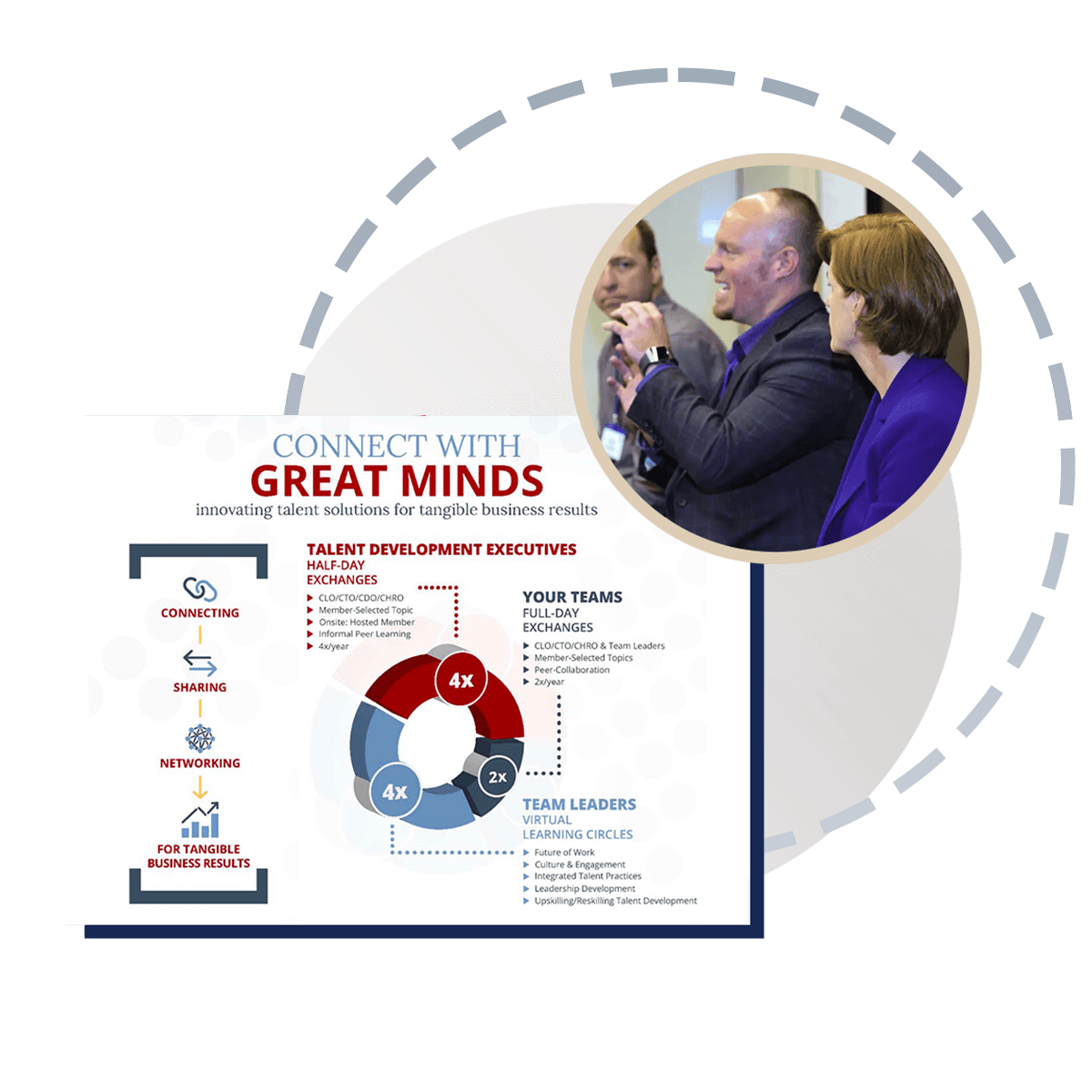
This highlight video is from March 12, 2026 ✨ AI Practical Lab: Context Is the Job.
"AI is cosmically stupid if it doesn't have context." — Christopher Lind
That line set the tone for everything that followed on March 12.
Anton Maletich brought a real problem to the room: Alter Domus is scaling fast, hiring junior officers straight out of university, and by week four those employees can't explain what the company does — let alone speak credibly with clients. Not a motivation gap. A mental model gap. The business needed a repeatable way to close it.
So the room built one. Live.
The live discussion brought together a sharp mix of senior talent and L&D leaders — from Alter Domus, Precisely, and Learning Sharks anchoring the conversation, to practitioners from Lurie Children's, PepsiCo, Discover, Zurich North America, Aon, CNA Insurance, insightsoftware, SunSource, FranklinCovey, Reynolds Consumer Products, and Waukesha County Technical College in the mix. The kind of room where the chat is as good as the main conversation — and it was.
The brief matters more than the tool.
Marty walked through the CRIT model live — Context, Role, Interview, Task — and built a 30-day onboarding framework for Alter Domus in real time, no proprietary data shared. The output was specific because the input was specific. The move most people admitted skipping: asking the AI to ask you clarifying questions before it responds.
"Full disclosure: CRIT was new to me in that room too. Marty pulled it from Geoff Woods' The AI-Driven Leader — and watching him run it live was one of those lightbulb moments where you think, why haven't I been doing this the whole time? Context, Role, Interview, Task. Four steps. Completely changes what comes back." — Dirk Tussing.
[caption id="" align="aligncenter" width="822"] The CRIT Model for AI-driven leadership, from Geoff Woods. (Credit: Google Gemini Banana)[/caption]
When the AI pressed Anton on where his junior officers actually break down, he got precise: it's not the legal structure — it's how accounting flows through it. That answer changed everything the AI produced. The diagnosis landed correctly. The room noticed.
You own the output.
Speed is real. So is the risk of using it uncritically. Christopher drew a hard line: if you can't answer detailed follow-up questions about what the AI produced, you haven't done the work.
"If you just use the results without analysis or reflection, you're not using it correctly." — David Scherer
And AI won't tell you when you're wrong — it's built to keep you engaged, not challenge you. You have to ask for the pushback explicitly.
Design the workflow, don't improvise it.
The practical split that landed: use outside-firewall tools for structure and frameworks, then move inside your approved environment to add sensitive detail.
"I'm looking for this tool outside your firewall to give structure. I can take that and put it inside the firewall and flesh out the detail." — Marty Murrillo, Precisely
Christopher added: build custom GPTs, Gems, or Claude Projects for work your team repeats — stakeholder interviews, onboarding design, needs assessments. Pre-load the context once. Anyone picks it up without starting cold.
What to try next
Use the CRIT model on one real work product this week. Add the Interview step — ask it to ask you up to three clarifying questions before responding. Early evidence: fewer revision cycles, more specific output.
Split your AI workflow deliberately. Map which parts happen outside the firewall (structure, options, frameworks) and which stay inside (proprietary detail). Make it a decision, not an accident. Early evidence: you can explain your process to InfoSec without hesitating.
Ask it to push back before you finalize. Prompt it directly: "What's wrong with this? What am I missing?" It won't do this unprompted. Early evidence: you'll catch at least one assumption you'd been treating as settled.
If any of these insights resonate — and you've got a top-of-mind talent business problem you'd like the ELE community to work on — send it our way. Members can submit their challenge here: Submit My Challenge Now