This highlight video is from November 12, 2026 ✨ AI Adoption Decisions -- What to Scale, Change, or Stop | AI Working Lab.
"You've won with adoption, you've lost with creating value for your customers."
— Newt Moore, Adjunct Professor, National Louis University
The talent challenge
Most organizations have rolled out AI tools. Far fewer can say whether the work got better. Patti Ouzounian set up the case: Halsted, a fictitious company spending about $1 million a year on AI, with no numbers to prove business value. Marketing cut turnaround from five days to one. Other teams hadn't picked a workflow yet, and they faced accuracy concerns, outdated training, unclear expectations and threatening policies. Usage targets drove costs up, while some employees did their work in personal AI accounts from home.
Halsted needed more discipline. That meant moving from a broad, license-driven rollout to focused AI use in defined workflows, with evidence of better outcomes and clear criteria for further investment. Many people leaders face that call now. The money is spent, and the next move has to be narrower.
Who joined
Guided by Patti Ouzounian (AI Workforce Transformation Strategist, ELE Group), Nicole DeFalco (CEO, Upsurge Advisors) and Vilson Simon (ELE Brazil & LATAM Community Director; Founder, Ágora Learning & Consulting). Mira Wolf (Learning and Development Leader) produced the Lab.
Who joined: Rachel Bentivenga (Sr. Learning & Development Analyst, William Blair), Matt Donovan (Chief Learning and Innovation Officer, GP Strategies), Michelle Feuillerat (Sr. Program Coordinator, Zurich North America), Craig Friedman (Learning Strategy Consultant and Author, St. Charles Consulting Group), Adrienne Guerrero (ELE Southwest Chicagoland Community Director; CEO, Positive Delta), DeBorah Lenchard (Director, Education & Talent Development), Newt Moore (Adjunct Professor, National Louis University), Greg Scott (Learning & Development Specialist, Brunswick) and Robert Snyder (Founder & President, Innovation Elegance).
How the Lab worked
Three breakout groups each took one seat at Halsted: HR and learning and development (L&D), people managers and workflow owners, and the AI Adoption Committee. Each group explored the case as people first. Then each ran an AI prompt for a 30/60/90-day plan and compared it with its own thinking. Nicole DeFalco named the experiment inside the experiment: would three functions working separately, then together, beat the way it usually happens at work?
What surfaced
1. Clear rules and a baseline come before the first prompt.
The HR and L&D group never got to its plan before naming a bigger gap. Nobody at Halsted knew what was expected.
"Is something mandatory? Is something optional? Is it improvisational? You can do what you want, or is it prohibited?"
— DeBorah Lenchard
Marketing's win didn't carry over on its own. Each department needed its own view of where AI adds value. The AI plan said the same thing: borrow from Marketing only what fits, and don't lift and shift.
The managers group moved one step forward. AI's plan set baseline measures at day 60. The group moved them to day one: start with the end in mind. They also wanted employees to help choose the workflow, and a quick check of each team's AI competence, confidence and proficiency first. Greg Scott added a data source most plans skip: IT can see "what our tokens are being consumed on," which shows what people actually ask for in the flow of work.
Which workflow would your employees pick, and could you state its baseline today?
2. Build the revision round, then protect the time it frees.
The AI Adoption Committee group's AI-drafted plan was tidy: charter the test and set measures by day 30, shift resources by day 60, decide to scale, change or stop by day 90. Craig Friedman saw the gap.
"There should be a feedback loop, because people are gonna probably get the first version of it wrong."
— Craig Friedman
Nicole DeFalco took it further. The 30/60/90 rule of thumb may need to stretch to 120 days, so the team gets a lessons-learned round and a second try before anyone decides to scale a process globally. The committee's real job, she said, is to guard the conditions that make a test work: HR capacity, IT data and protected time for employees.
Craig pointed to a simple habit from IT: design and test on the side before you promote to production. Innovating while you deliver client work is hard because every mistake has real consequences. "I'm gonna create a bot tonight and test it out tomorrow. It's terrifying for people." The group asked for a safe place to practice and the time to use it.
Then Craig raised the problem that sits under every productivity claim.
"If you really want to drive efficiency, you've got to address the infinite backlog problem."
— Craig Friedman
Speed up a task and people don't stop at seven hours. They dig deeper into the to-do list, often into lower-value admin work. Adrienne Guerrero's answer: we will never catch up, so it's about what really matters.
Where will the hours you save go, and who decides?
3. Adoption isn't value.
Newt Moore wanted the context before the plan: what Halsted sells, where its revenue comes from, and whether its business model is changing. You can adopt and fail. Everyone can be using AI while revenue falls.
His fix is a coalition, not a department. That means finance, compliance, leaders and "the people on the floor" redesigning the work together, at the point where the work happens. He described taking students to a restaurant using a point-of-sale system to question employees and managers instead of guessing from a classroom.
Nicole named where that leads: get into the trenches and you may say no to AI more often than yes. Patti Ouzounian took the point back to the community. The next Labs need to look past using the tool and treat business value as the end result.
When did someone on your team last watch the work before choosing the tool?
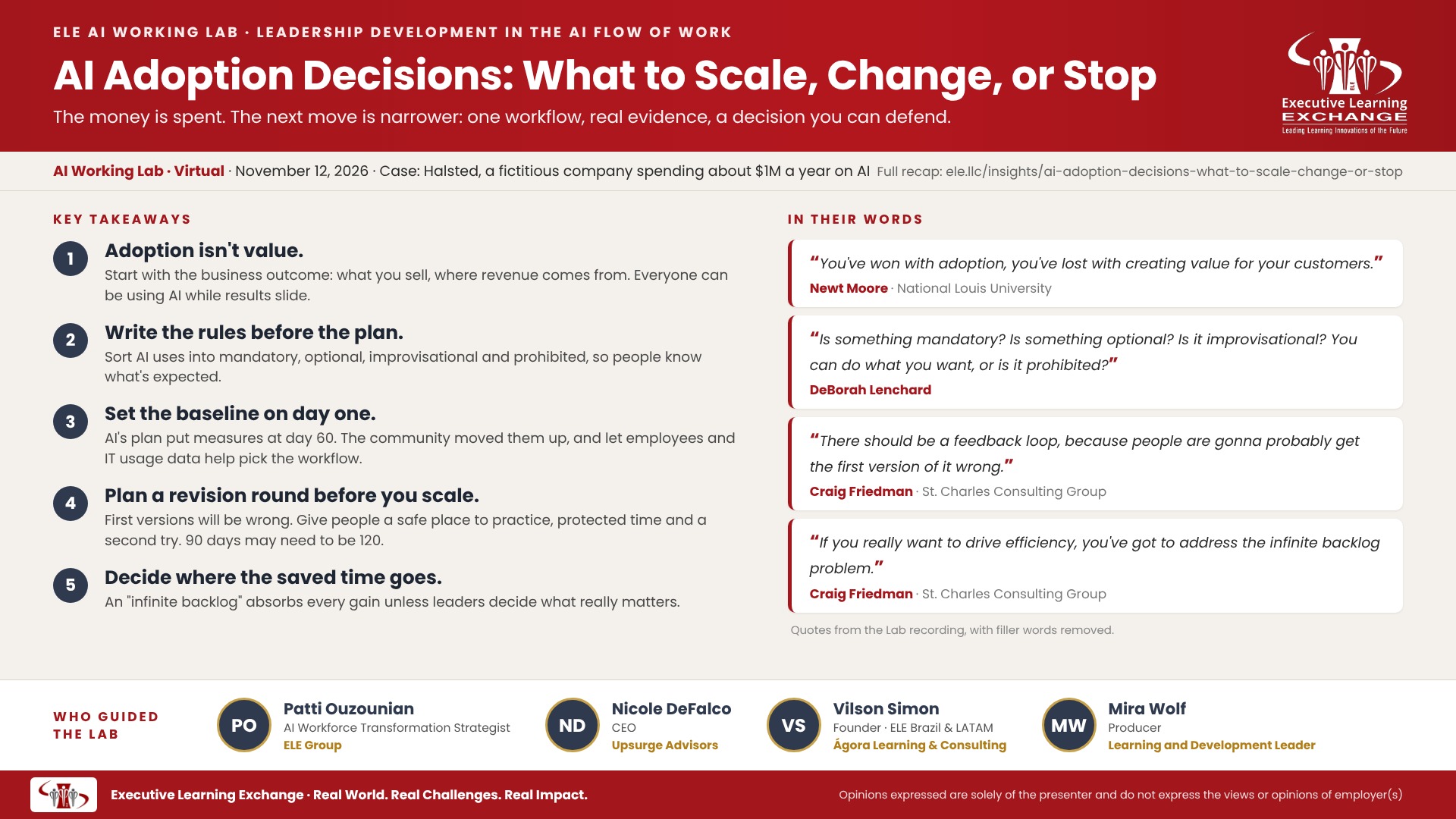
Key takeaways at a glance
What to try next (within 30 days)
- Sort your AI uses into four buckets: mandatory, optional, improvisational and prohibited. Share the list with managers before you launch anything new. Early sign it's working: managers answer "Can I use AI for this?" without escalating, and personal-account use comes up in conversation instead of staying hidden.
- Choose one workflow with the people who do it, and write down its baseline before anything changes. Ask IT what usage data shows people asking for. Early sign: you can state today's turnaround time and error rate for that workflow in one sentence.
- Write a revision round and protected practice time into the plan before the scale decision, and decide now where saved hours go. Early sign: after the first round, the team names one prompt, guardrail or step it changed, plus what it did with the time it got back.
Closing
Halsted didn't need more tools. It needed a sharper question: is the work getting better? Add what you've tried in the Idea Exchange Post-Chat. If your organization faces its own scale, change or stop decision, bring it to the community through Shape the Calendar.
What we learn in these Labs feeds In Search of Organizational Excellence, ELE's fourth book.