- #disruptivethinking panel: Do organizations need a comprehensive skills framework?
- Teri Hart, Zurich Insurance
- Dirk Tussing, ELE
- Wendy Greeson, SMS Assist
- Robin Hoke, Marquette University
- Leadership Development Skill Analysis - What Leadership Development Should Look Like in the Hybrid Era?
 Teri Hart, the author of Hardwired to Learn, shared insights on Your Learning Needs a Comprehensive Strategy a few years ago for ELE. During this strategy session, Teri illustrated that we are frequently tasked to build learning solutions to solve business problems. Quite often, these needs appear to be a worthwhile investment. But without the backdrop of strategy, we miss a critical piece of the decision-making framework – the relative value of specific learning needs a decision.
Let's have Teri help guide a disruptive thinking roundtable panel on how HR functions can drive a Comprehensive Skills Framework to ensure business alignment.
💥 Talent functions that don’t have strategic planning capability are likely not focused on the right work.
Organizations need a dynamic approach to teaching people new skills. We see that integrated talent practices based on skills are rising, and business leaders are talking about skills.
Teri Hart, the author of Hardwired to Learn, shared insights on Your Learning Needs a Comprehensive Strategy a few years ago for ELE. During this strategy session, Teri illustrated that we are frequently tasked to build learning solutions to solve business problems. Quite often, these needs appear to be a worthwhile investment. But without the backdrop of strategy, we miss a critical piece of the decision-making framework – the relative value of specific learning needs a decision.
Let's have Teri help guide a disruptive thinking roundtable panel on how HR functions can drive a Comprehensive Skills Framework to ensure business alignment.
💥 Talent functions that don’t have strategic planning capability are likely not focused on the right work.
Organizations need a dynamic approach to teaching people new skills. We see that integrated talent practices based on skills are rising, and business leaders are talking about skills.
 💥 Taking a skills-based approach to building the future workforce (McKinsey, Nov 2022)
Unfortunately, i4cp research has found many organizations are merely guessing when it comes to crucial aspects of that equation, especially knowing their employees' skills and capabilities. When organizations build an employee skills inventory or database, what do they include in the talent profiles? a common language to describe skills in the organization and enable an agile workforce by using skills as the common currency of the business. It helps integrate talent management processes.
💥 What Leadership Development Should Look Like in the Hybrid Era
Key findings from Effective Leadership in a Hybrid World of Work (Udemy, December 2022) revealed that:
💥 Taking a skills-based approach to building the future workforce (McKinsey, Nov 2022)
Unfortunately, i4cp research has found many organizations are merely guessing when it comes to crucial aspects of that equation, especially knowing their employees' skills and capabilities. When organizations build an employee skills inventory or database, what do they include in the talent profiles? a common language to describe skills in the organization and enable an agile workforce by using skills as the common currency of the business. It helps integrate talent management processes.
💥 What Leadership Development Should Look Like in the Hybrid Era
Key findings from Effective Leadership in a Hybrid World of Work (Udemy, December 2022) revealed that:
Hybrid work doesn’t fundamentally change what’s required to be an effective leader, but some skills are increasingly essential to manage mixed teams successfully.
Let's analyze skills for how leaders develop beyond the theory that 70% of learning happens through doing (on-the-job experience), 20% through feedback and greater self-awareness (gained via interactions with others), and 10% through formal training. Quantitative and qualitative research conducted over the past three years points (2022, HBR: What Leadership Development Should Look Like in the Hybrid Era) to an alternative—a framework for the process that emphasizes three actions:- Sensemaking, or understanding how the business world and the organization work around you and how others relate to you.
- Experimenting. or testing ideas picked up in a classroom session, from colleagues, or from personal experience.
- Self-discovery, or figuring out your own identity in the workplace.
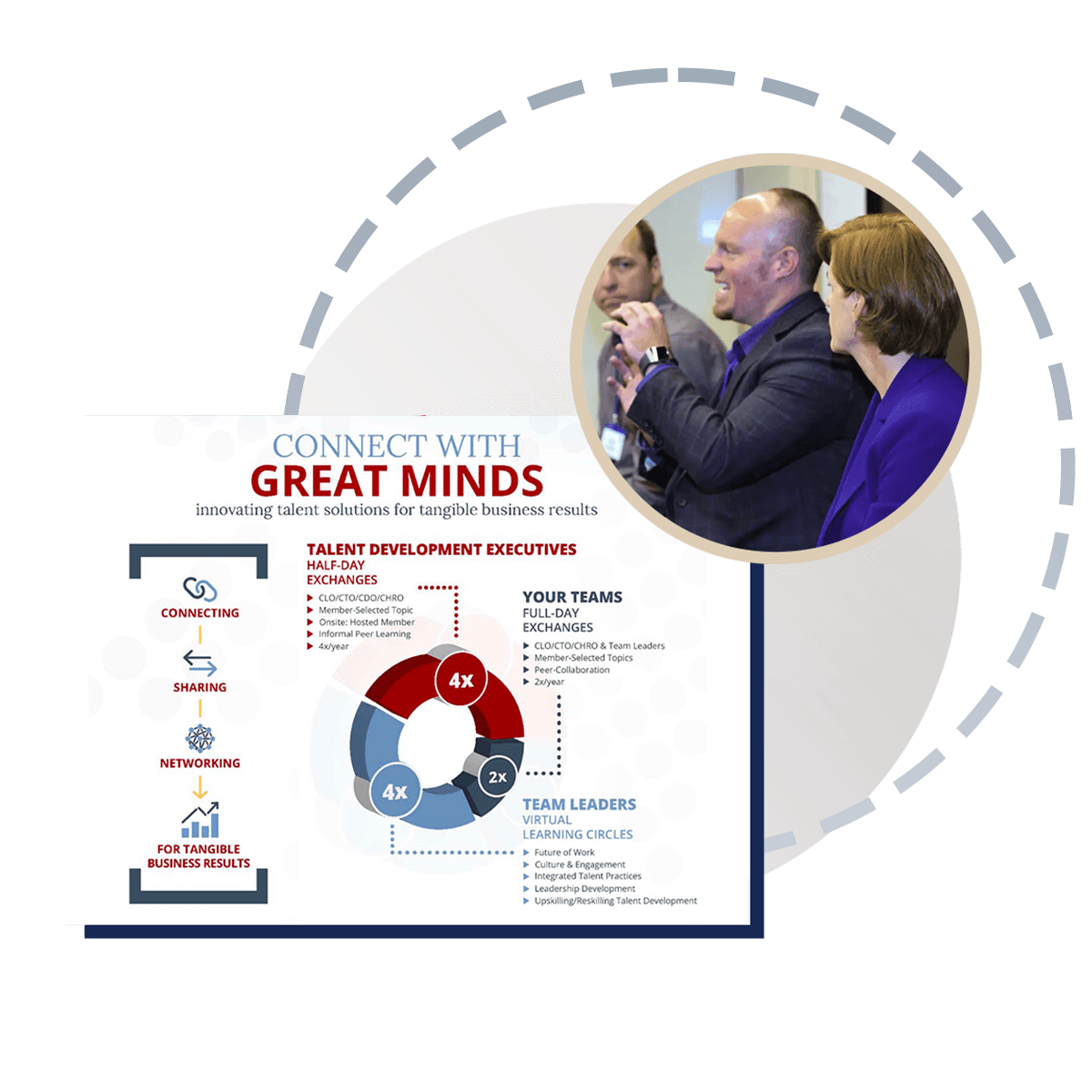
 ELE's Wisconsin cohort for Learning & HR Executives is a year-long learning process through face-to-face collaboration and networking with other local heads of Learning & Talent Development. Each senior leader is encouraged to bring a peer from their organization that contributes to, engages, or supports the Learning & Talent spectrum for their workplace.
Our quarterly cohort exchanges use the following design elements:
ELE's Wisconsin cohort for Learning & HR Executives is a year-long learning process through face-to-face collaboration and networking with other local heads of Learning & Talent Development. Each senior leader is encouraged to bring a peer from their organization that contributes to, engages, or supports the Learning & Talent spectrum for their workplace.
Our quarterly cohort exchanges use the following design elements:
- Sharing practical case studies aligned to business needs
- Identifying key issues and developing insights and solutions
- Canvassing learning industry trends applied at ELE members’ workplace
ELE produces this Wisconsin CLO Group.